TECHNOLOGY
The Wright Brothers' First Flight
1903 CE
History · Contemporary · Holocene · Meghalayan
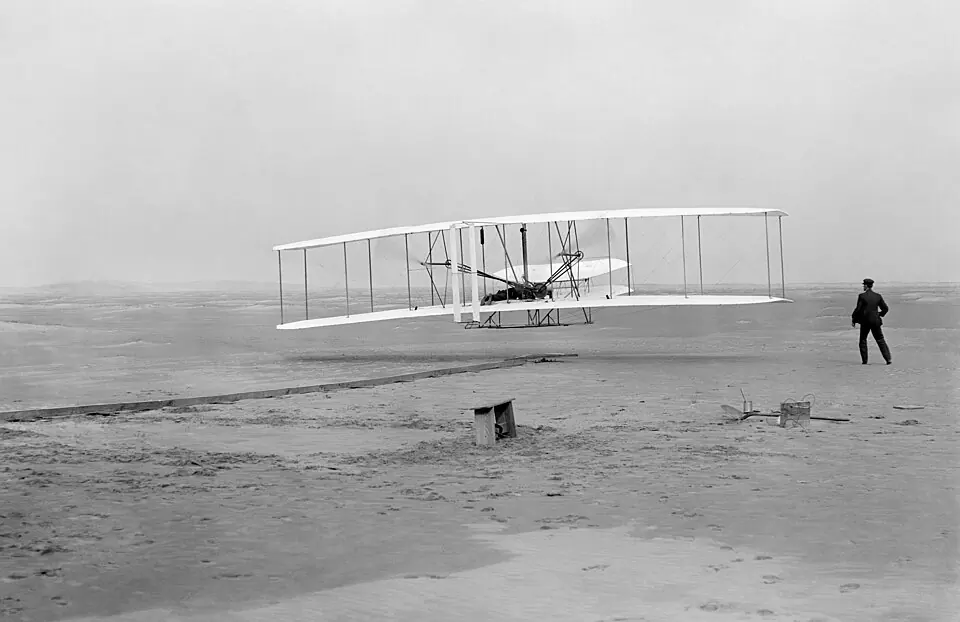
On 17 December 1903, at Kitty Hawk, the Wright brothers' machine made the first controlled, sustained and powered flight of a heavier-than-air craft: twelve seconds and thirty-six metres.
On 17 December 1903, at Kitty Hawk, North Carolina, the machine of the Wright brothers made the first controlled, sustained and powered flight of a heavier-than-air craft: twelve seconds and thirty-six metres for the first of the day's four flights. The decisive contribution bears on control, exercised about three axes: pitch, movement of the nose up or down; roll, lateral inclination of the wings; yaw, rotation of the nose left or right. These movements are not independent, the inclination of the wings producing sideslip. The Wrights coupled wing warping to the rudder, so that a single command corrects both effects. The result rests on a methodical programme of gliders, wind tunnel measurements and piloting practice.
Why it matters
Aviation modifies practicable distances and simultaneously affects transport, military operations, migration and the diffusion of infectious agents. The case further illustrates a method of invention founded on systematic experiment and the production of one's own data, as against earlier attempts resting on observation and intuition; the predecessors, from Cayley to Lilienthal, who died in 1896 in a glider flight, had established the principles of lift without solving that of control.
Dating & uncertainty
The four flights of 17 December 1903 constitute the first controlled and sustained flights of a powered heavier-than-air machine. The result proceeds from documented engineering work, and not from an isolated trial: three-axis control is its decisive element.
Our species’ history as one day
23:59:2633.7 s before midnight
if the 315,000 years of Homo sapiens were compressed into a single day