HEALTH
The 1918 Influenza Pandemic
1918 CE
History · Contemporary · Holocene · Meghalayan
The 1918 influenza, an H1N1 virus of avian origin, swept the world in two waves in the last year of the First World War and killed mainly adults between twenty and forty.
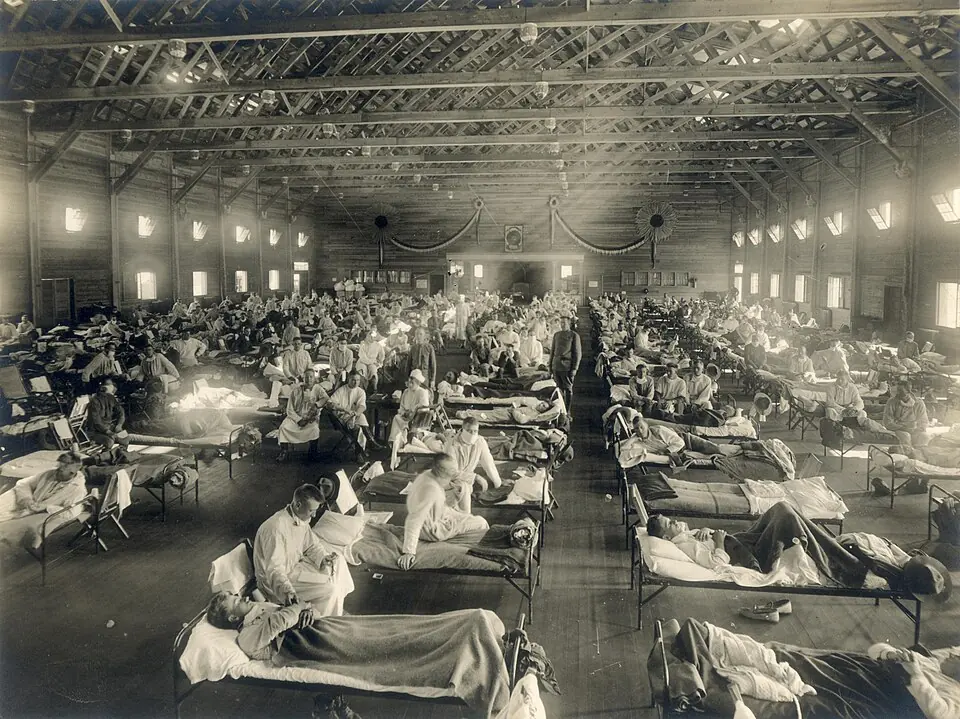
The 1918 influenza pandemic, due to an H1N1 subtype virus of avian origin, spread in two successive waves worldwide during the last year of the First World War. Its mortality presents an unusual age distribution, excess mortality affecting principally adults between twenty and forty. Estimates of the number of deaths range from 17 to 100 million. The designation Spanish flu does not refer to its origin: Spain being neutral and not having subjected its press to wartime censorship, the epidemic was publicly reported there while belligerent countries suppressed it. The virus itself was characterised only eight decades later, from blocks of lung tissue taken at autopsies in 1918 and preserved in paraffin by the United States Army, and from the body of a woman buried in Alaskan permafrost.
Why it matters
Later influenza pandemics derive from this strain, the lineages issuing from the 1918 H1N1 remaining in circulation. The episode constitutes the reference scenario for pandemic preparedness. Two questions remain open: the cause of excess mortality in young adults and the estimate of the total number of deaths.
Dating & uncertainty
The epidemic waves run from early 1918 to 1919. The toll is the most debated part: from 50 to 100 million deaths on the most cited estimates, reduced to about 17 million by a reanalysis of mortality registers published in 2018. The place of transmission to humans remains undetermined, a North American origin being most often retained, a European origin having also been defended.
Our species’ history as one day
23:59:3029.6 s before midnight
if the 315,000 years of Homo sapiens were compressed into a single day