TECHNOLOGY × SUBSISTENCE
The Haber-Bosch Process
1908 CE
History · Contemporary · Holocene · Meghalayan
The Haber-Bosch process, from 1908, makes ammonia from the nitrogen of the air, which plants cannot use on their own, and about half the nitrogen in a human body today comes from it.
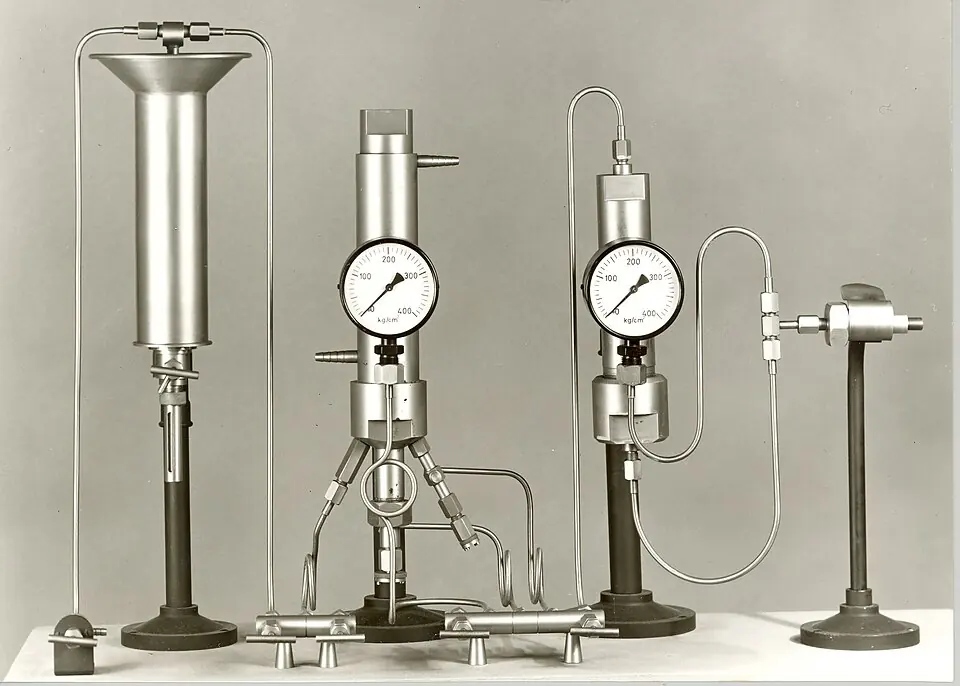
The Haber-Bosch process is the industrial synthesis of ammonia from atmospheric nitrogen and hydrogen. Nitrogen constitutes nearly four fifths of the atmosphere but remains there inaccessible to plants: it occurs as diatomic molecules whose two atoms are joined by a triple bond, among the most stable in chemistry, broken only by certain bacteria by means of a specialised enzyme. Fritz Haber, whose patent was filed on 13 October 1908, obtains that rupture by extreme conditions, of the order of five hundred degrees and several hundred atmospheres in the presence of a catalyst; Carl Bosch and the BASF company effect the transition to industrial scale. Both receive the Nobel Prize in Chemistry, in 1918 and 1931. The production of nitrogen fertiliser that results sustains twentieth-century agricultural yields.
Why it matters
About half the nitrogen contained in a present-day human organism derives from this process. Analyses of the nitrogen cycle establish that the demographic growth of the twentieth century, from 1.6 billion inhabitants in 1900 to six billion in 2000, would not have been possible without it. The same process supplies the basis of synthetic explosives, Haber having moreover directed the first uses of chemical weapons, and the reactive nitrogen released into the environment constitutes today a major source of eutrophication of inland waters and of atmospheric emissions.
Dating & uncertainty
The patent bearing on the synthesis of ammonia from its elements is filed in 1908, industrialisation following in subsequent years. The demographic estimate proceeds from work on the nitrogen cycle and not from a general extrapolation.
Our species’ history as one day
23:59:2732.4 s before midnight
if the 315,000 years of Homo sapiens were compressed into a single day