SOCIETY × TECHNOLOGY
Angkor and Its Waterworks
~1150 CE
History · Middle Ages · Holocene · Meghalayan
Angkor, capital of the Khmer empire from the ninth to the fourteenth century, was one of the most extensive low-density cities of the pre-industrial world, which lidar has now mapped.
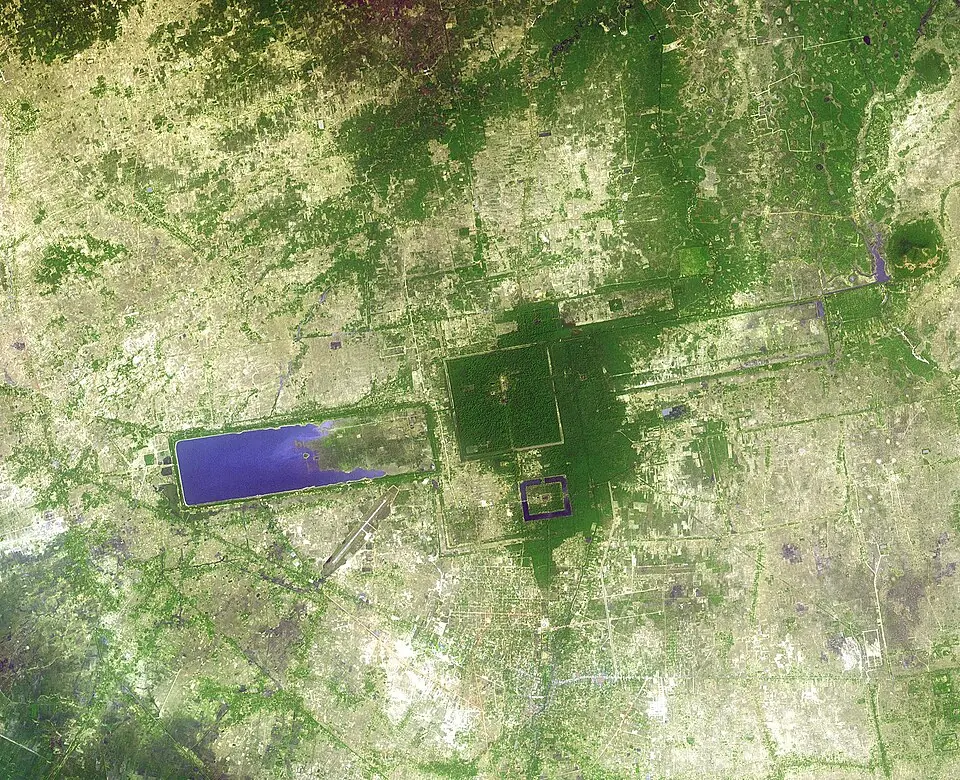
Angkor, the capital region of the Khmer empire from the ninth to the fourteenth century, inscribed as a World Heritage site in 1992, constitutes one of the most extensive low-density agglomerations of the pre-industrial world. Around the monumental complexes, lidar remote sensing, an acronym designating distance measurement by laser, has revealed settlement dispersed across the countryside: house mounds, plots, canals, two reservoirs of some fifteen square kilometres each and more than three thousand household ponds. The principle of the method lies in its density of fire: the aircraft emits hundreds of thousands of pulses, a small proportion of which reach the ground between the foliage, and selecting only the latest echoes restores the relief beneath forest cover. The whole constitutes a hydraulic network. Modelling of that network shows how the irregularities of the fourteenth-century monsoon could place it in default, a local damage propagating step by step to general failure.
Why it matters
Angkor provides the first precise documentation of infrastructure vulnerability in an ancient city, the determining factor being neither agricultural production nor military situation but the interdependence of the elements of the network. The authors of the model explicitly establish the comparison with contemporary critical infrastructure. Laser remote sensing has moreover modified archaeological expectations concerning forested regions.
Dating & uncertainty
The date retained corresponds to the twelfth-century peak, the period of the building of Angkor Wat. The causes of the end of the Angkorian period remain debated: network modelling establishes its sensitivity to cascading failure under the alternations of drought and flood of the fourteenth century, while remote sensing indicates that urban transformations linked to political unrest were under way before the most severe climatic episodes.
Our species’ history as one day
23:55:594 min before midnight
if the 315,000 years of Homo sapiens were compressed into a single day