TECHNOLOGY × SOCIETY
Gutenberg and the Printing Press
~1450 CE
History · Middle Ages · Holocene · Meghalayan
Around 1450, at Mainz, Johannes Gutenberg's press with movable metal type turned the book, until then copied by hand over months, into a manufactured object.
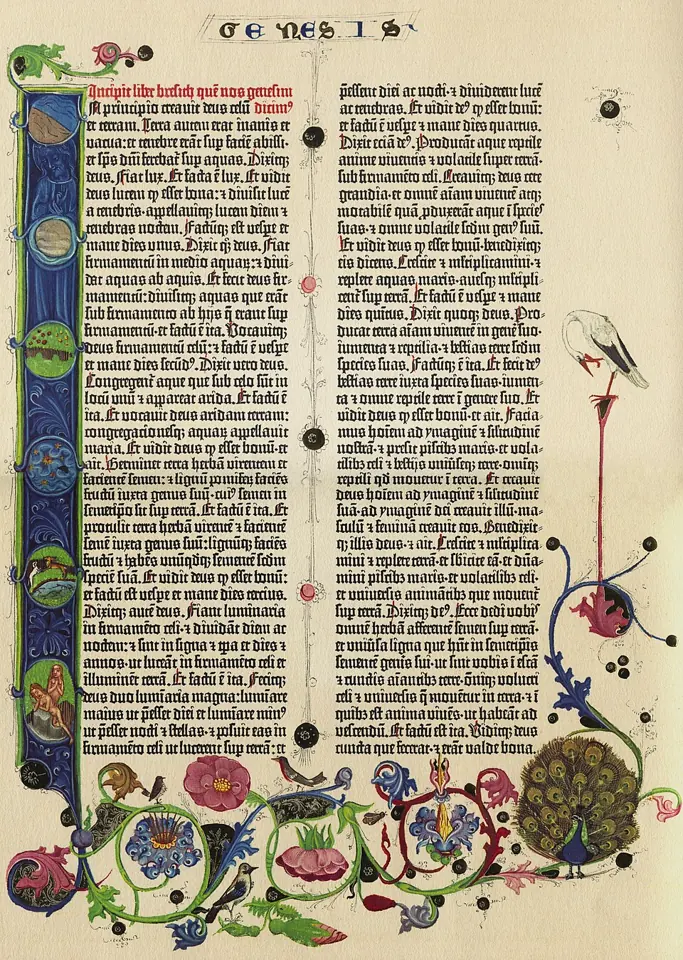
The press with movable metal type, developed by Johannes Gutenberg at Mainz around 1450 and whose forty-two-line Bible constitutes the first major production, transforms the book, until then copied by hand over several months, into a manufactured object. Its effects have been measured at urban scale: European cities possessing a press before 1500 record over the following century growth 60 per cent higher than comparable cities, and adopt the Reformation in markedly higher proportion. Initial establishment further follows the geography of skills, the technique settling preferentially in cities already possessing clockmakers, that is, artisans of precision metalwork.
Why it matters
Printing constitutes the reference case for the study of the effects of a fall in the cost of information: acceleration of commercial exchange, diffusion of writings beyond the control of the institutions that held the monopoly, and rapid propagation of polemical texts at continental scale. Economic research employs it as a term of comparison for digital technologies, including as regards the difficulty of distinguishing what the technique causes from what it conveys.
Dating & uncertainty
The press operates at Mainz around 1450, the economic measurements bearing on the following centuries. The estimate of 60 per cent higher growth requires setting aside an objection: a prosperous city may acquire a press for that very reason, which would reverse the causality. The method adopted uses distance from Mainz as an instrumental variable, nearby cities having received the technique early for a reason independent of their economic situation.
Our species’ history as one day
23:57:222 min 38 s before midnight
if the 315,000 years of Homo sapiens were compressed into a single day