TECHNOLOGY × SOCIETY
The Transatlantic Telegraph Cable
1866 CE
History · Contemporary · Holocene · Meghalayan
The transatlantic cable laid in 1866 cut the delay of a message between Europe and North America from about ten days, the length of a crossing, to one.
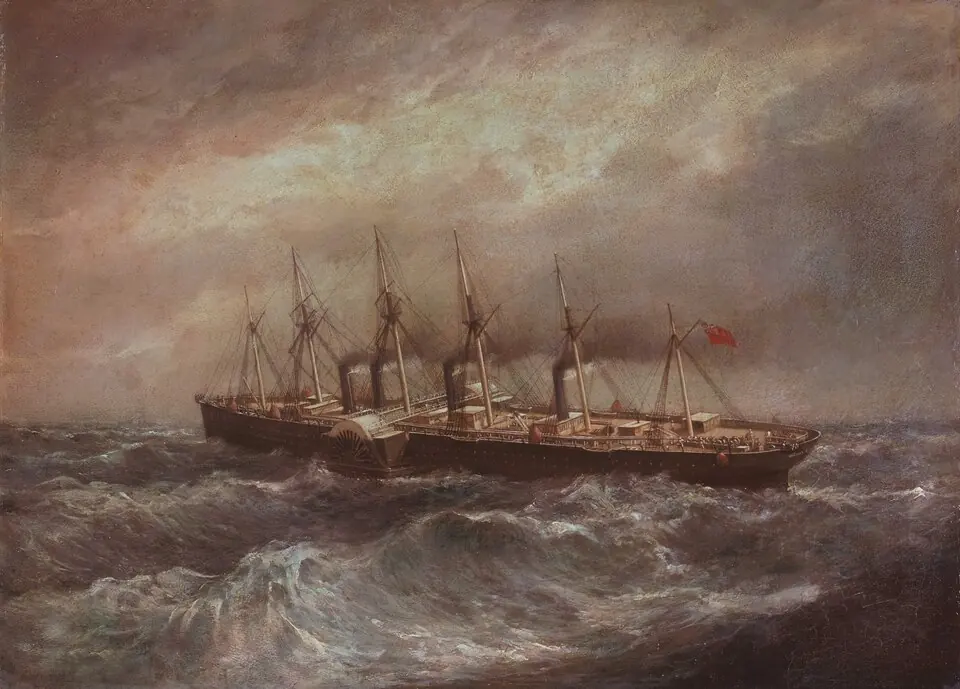
The transatlantic telegraph cable laid in 1866 by the Great Eastern establishes the first durable link between Europe and North America, reducing to one day a transmission delay until then set by the duration of a crossing, some ten days. The economic effect is measured on the cotton markets of New York and Liverpool. The mechanism is as follows: a merchant ignorant of the price prevailing on the other shore buys without information and applies a margin intended to cover the risk of error over the duration of the crossing; knowledge of the day's price removes that margin, and the price difference between the two centres is reduced to the real cost of transport. Measurements establish a narrowing and stabilisation of that difference, an increase in trade and a faster response to demand, efficiency gains being estimated at 8 per cent of export value.
Why it matters
The telegraph dissociates for the first time the speed of circulation of information from that of persons and goods, which remained dependent on steam. It brings information into view as a distinct economic good, whose absence has a measurable cost. Later accelerations, telephony, computer networks and algorithmic transmission of market orders, reproduce the same pattern.
Dating & uncertainty
Land telegraphy spreads from the 1840s; 1866 is the year of the first durable transatlantic cable. The measured effects bear on trade: narrowing of the price gap between New York and Liverpool, increase in exports, and a reanalysis of the American rollout concludes to distortions removed half as large as first estimated.
Our species’ history as one day
23:59:1643.9 s before midnight
if the 315,000 years of Homo sapiens were compressed into a single day