TECHNOLOGY
The Newcomen Steam Engine
~1712 CE
History · Early Modern · Holocene · Meghalayan
The Newcomen engine, at work by 1712, was the first heat engine in industrial use, burning coal at the pithead to pump out the water that flooded the mines.
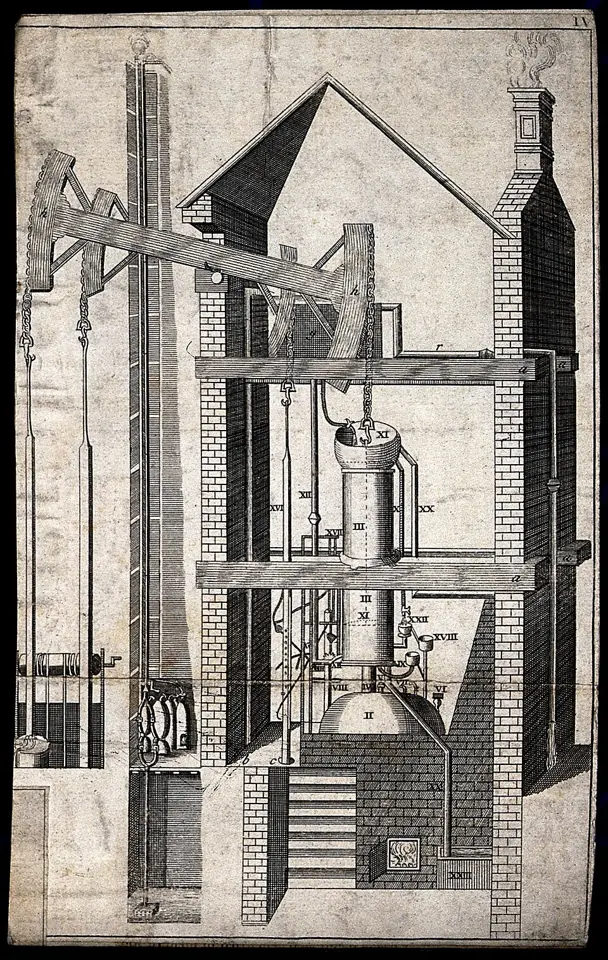
The Newcomen atmospheric engine, whose oldest documented working example dates from 1712, is the first thermal engine of industrial use. Its function is drainage, that is, the removal of water from mines, coal burned at the pithead serving to raise the water that floods them. The qualifier atmospheric describes the principle: the steam exerts no thrust, it fills the cylinder, a jet of cold water condenses it, and atmospheric pressure then acts on the piston in the vacuum so created. The available force is consequently capped by air pressure, which explains the very low efficiency and high consumption of these machines. The separate condenser patented by Watt in 1769, then rotary motion in the 1780s, extend their use to industry; high pressure, in the nineteenth century, introduces steam as a motive force and makes locomotion possible.
Why it matters
The thermal engine substitutes fossil carbon for earlier energy sources, muscular force, wind and falling water, whose availability was locally capped. The chronology of its economic effect is by contrast delayed: growth accounting places the maximum contribution of steam to the British economy after 1850, nearly a century and a half after the first engine, which constitutes a reference case on the lag separating an invention from its macroeconomic effects.
Dating & uncertainty
Atmospheric engines appear at the beginning of the eighteenth century, first for drainage; 1712 is the date of the oldest documented example in service. The decisive stages are later: rotary motion in the 1780s, industrial generalisation, then high pressure in the nineteenth century, growth accounting placing the peak of the effect after 1850.
Our species’ history as one day
23:58:331 min 26 s before midnight
if the 315,000 years of Homo sapiens were compressed into a single day