TECHNOLOGY × SOCIETY
The First Intercity Railway
~1830 CE
History · Contemporary · Holocene · Meghalayan
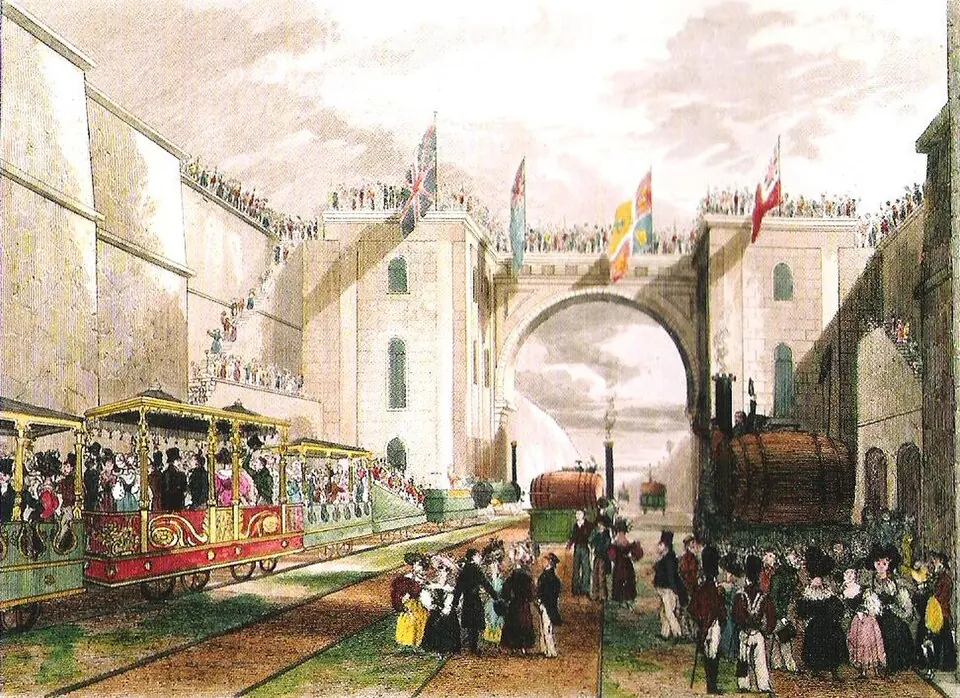
The Liverpool and Manchester line, opened in 1830, was the first railway between two cities worked entirely by steam, and its effect shows in the price of farmland.
The inter-city railway is established from 1830, the year of opening of the Liverpool and Manchester line, the first connection between two cities operated entirely by steam traction. Its effects have been quantified using the value of agricultural land as indicator, for a direct economic reason: a holding is worth only the product of its harvest less the cost of conveying it to market, so that a fall in that cost increases the revenue the land can procure, which its price records. In the United States, the extension of the network between 1870 and 1890 raises land values wherever it improves a county's access to markets; removing the 1890 network in a counterfactual model, which restores to each county the journey it would have had without rail, subtracts about 60 per cent of that value. In Britain, the value of time saved by travellers exceeds a tenth of national income by 1912.
Why it matters
The railway modifies the geographic constraint: the localities served reorganise their production, settlement and prices around the line, while others suffer a lasting disadvantage. It produces mass travel, markets of national dimension and the unification of time. It constitutes, finally, one of the cases most used in economics to establish that transport infrastructure is not merely an expenditure but a factor of growth, whose return is greatest where the available alternative is most costly.
Dating & uncertainty
The date retained corresponds to the opening of the first inter-city lines, around 1830, the measurements bearing on the following decades. For the United States, removing the 1890 network in a model erases about 60 per cent of agricultural land value, more recent work concluding to higher aggregate productivity gains.
Our species’ history as one day
23:59:0653.8 s before midnight
if the 315,000 years of Homo sapiens were compressed into a single day