GENETICS
Mendel and the Laws of Heredity
1866 CE
History · Contemporary · Holocene · Meghalayan
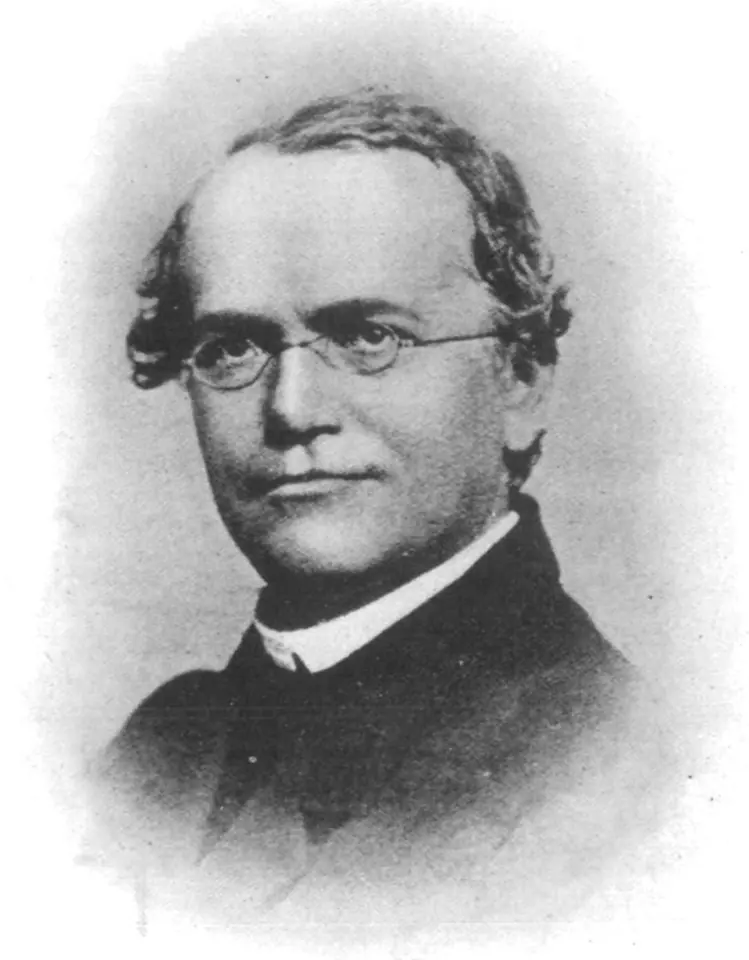
Gregor Mendel, a monk in Brno, grew some ten thousand pea plants and found constant numerical ratios in their offspring: the laws of heredity, published in 1866.
Gregor Mendel, an Augustinian monk at the Abbey of Saint Thomas in Brno, cultivated between 1856 and 1863 about ten thousand pea plants and followed seven contrasting characters through crosses, establishing constant numerical ratios where the accepted theory assumed a blending of parental characters. The calculation is as follows: each plant carries two copies of each character, one from each parent, one of which may mask the other; crossing two plants each carrying one visible and one masked copy produces on average one descendant in four having inherited only masked copies. This ratio of three to one, found across all seven characters, establishes transmission by discrete units and not by blending. The results, published in 1866 in the proceedings of the Brno natural history society, remain without posterity for thirty-four years.
Why it matters
Mendel's laws supply the hereditary mechanism lacking in the theory of natural selection, without which variation would be diluted at each generation. The methodological contribution is of equal reach: the introduction of counting and the calculation of proportions into the study of heredity, an approach sufficiently foreign to the biology of the period that his contemporaries did not recognise its nature. The whole genetic vocabulary used in this edition proceeds from it.
Dating & uncertainty
Mendel presented his results in 1865 and published them in 1866; their significance was recognised only in 1900, on the independent rediscovery of the same laws. Genomics identified in 2025 the variants corresponding to the seven characters, including deletions and insertions, the fasciated stem being explained only in combination with a modifier locus. The unusual statistical regularity of his results remains debated.
Our species’ history as one day
23:59:1643.9 s before midnight
if the 315,000 years of Homo sapiens were compressed into a single day