TECHNOLOGY × ENVIRONMENT
Trinity and the First Nuclear Test
1945 CE
History · Contemporary · Holocene · Meghalayan
The first nuclear test, Trinity, took place on 16 July 1945 in New Mexico, and the atmospheric tests that followed spread artificial radionuclides across the planet.
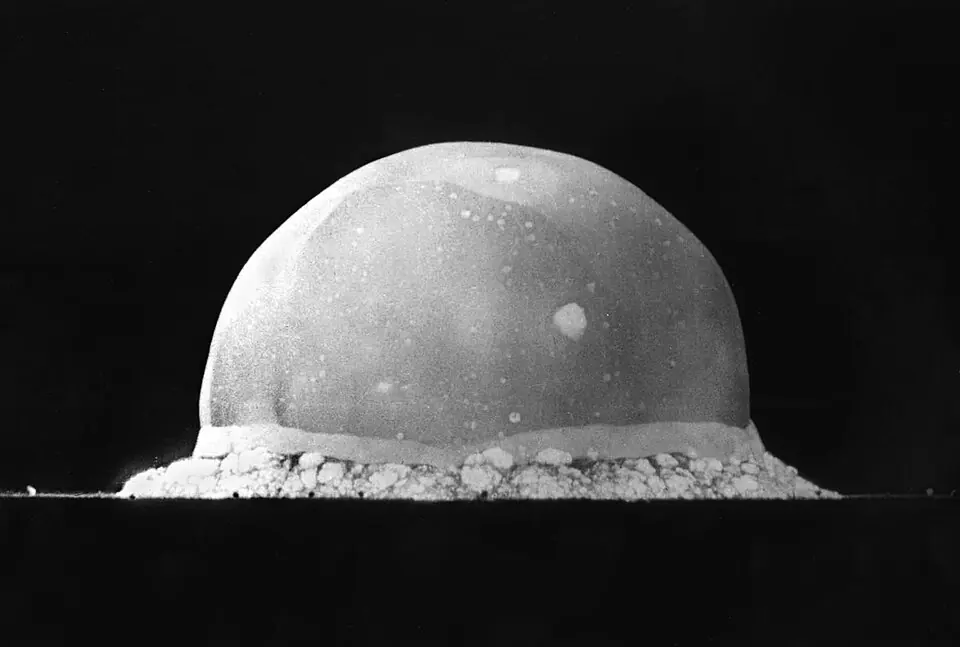
The first nuclear test, named Trinity, takes place on 16 July 1945 near Alamogordo, New Mexico; the bombings of Hiroshima and Nagasaki follow in August. The atmospheric test campaigns conducted subsequently over several decades disperse artificial radionuclides at planetary scale. Plutonium-239 now constitutes an identifiable level in lake sediments and ice worldwide, and the radiocarbon produced by these tests marks the same years in corals and tree rings. The sharpness and universality of this signal have led to its being proposed as a stratigraphic marker of the Anthropocene.
Why it matters
The radiocarbon spike produced by the tests further constitutes a dating instrument: a tissue is constituted from the carbon available in the year of its formation, and the tests conferred on each year since the 1950s a characteristic content, first increasing then decreasing. Measuring that content in dental enamel or in a cell population therefore allows the formation of the tissue to be dated, a method employed in forensic medicine as in developmental biology.
Dating & uncertainty
The Trinity test dates from July 1945. The stratigraphic signal results from the atmospheric test series: plutonium-239 appears in sediments in the early 1950s, peaks in the 1960s and decreases through the 1970s after the partial test ban of 1963; radiocarbon and iodine-129 record the same peak. Among these three markers, only iodine-129 possesses a half-life sufficient to remain detectable in the very long term.
Our species’ history as one day
23:59:3722.2 s before midnight
if the 315,000 years of Homo sapiens were compressed into a single day