TECHNOLOGY
Pearl Street: the First Power Station
1882 CE
History · Contemporary · Holocene · Meghalayan
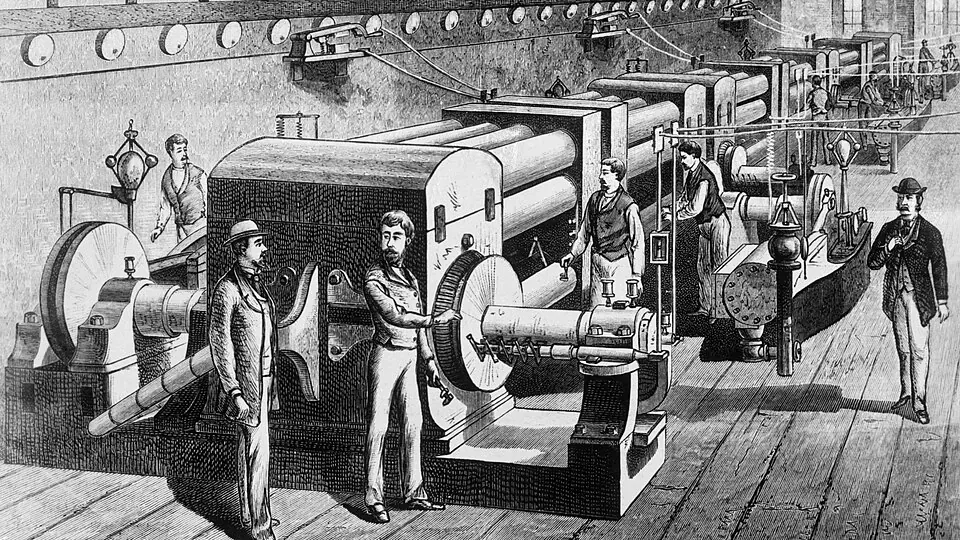
Edison's Pearl Street station, switched on in Manhattan in September 1882, was the first central power network, supplying current to a whole district as a service.
The Pearl Street station, brought into service by Edison in Manhattan in September 1882, is the first central electrical network: current there becomes a service distributed to a district rather than a local production. The electrification of industrial establishments is by contrast slow, and its effect on productivity appears only in the 1920s. The reason lies in the material organisation of earlier workshops: a single steam engine drove a line shaft, a rotating axle beneath the ceiling, to which each tool had to be connected by belt, which required machines to be grouped around that axle and subordinated the plan of the building to the transmission. Assigning an electric motor to each machine removes that constraint and allows the workshop to be organised according to the sequence of operations. It is this reorganisation, and not lighting, that produces the measured gain.
Why it matters
The forty-year lag separating the establishment of the network from the appearance of productivity gains constitutes the reference case on the temporality of so-called general-purpose technologies, and is regularly invoked concerning computing and machine learning systems: the economic effect follows the reorganisation of uses and not the installation of the device.
Dating & uncertainty
The Pearl Street station supplies lower Manhattan from September 1882. The productivity surge attributed to industrial electrification occurs only in the 1920s. The membership of electricity in the category of general-purpose technologies has been questioned by a study based on patent citations.
Our species’ history as one day
23:59:2039.5 s before midnight
if the 315,000 years of Homo sapiens were compressed into a single day