ENVIRONMENT
The Little Ice Age
~1250 CE
History · Middle Ages · Holocene · Meghalayan
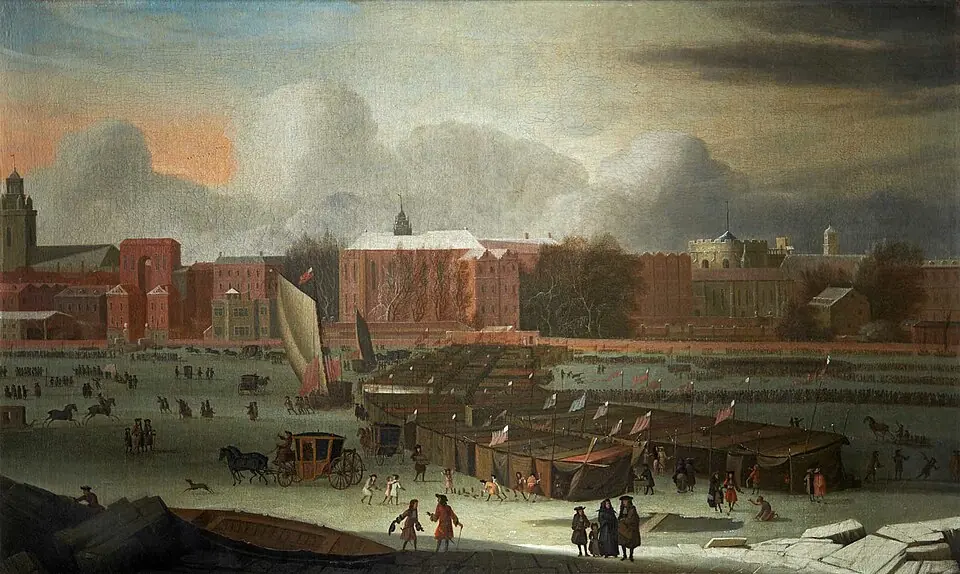
From about 1250 to the mid-nineteenth century, Europe and much of the northern hemisphere cooled, with advancing Alpine glaciers and a Thames that regularly froze.
The Little Ice Age designates a period of cooling affecting Europe and much of the northern hemisphere between about 1250 and the mid-nineteenth century, marked by the advance of Alpine glaciers, the regular freezing of the Thames and the accumulation of references to severe winters in written sources. The factors are ranked: series of volcanic eruptions first, minima of solar activity to a markedly lesser degree, the whole being amplified by the albedo feedback. That mechanism operates as follows: a sea surface that freezes reflects back to space the radiation dark water absorbed, which lowers local temperature further and extends the ice, the cooling then sustaining itself well after the dissipation of the volcanic aerosol that triggered it. The period ends with a series of nineteenth-century eruptions, including that of Tambora, the exit coinciding with the beginning of anthropogenic warming.
Why it matters
The period constitutes the climatic frame of part of modern European history, and documents the effects of a modest thermal departure maintained over several centuries. It further complicates the definition of the pre-industrial reference state used to measure contemporary warming, that state corresponding itself to the exit from a cold phase of volcanic origin.
Dating & uncertainty
European reconstructions place the period between about 1250 and 1860, probably the coldest of the last 8,000 years on the continent; a hemispheric definition of 1440 to 1920 is also defended, and the period includes phases that were not cold. The principal drivers are series of volcanic eruptions, grand solar minima contributing more weakly, with amplification by sea ice and the ocean; the Maunder Minimum alone does not suffice to account for the phenomenon.
Our species’ history as one day
23:56:273 min 33 s before midnight
if the 315,000 years of Homo sapiens were compressed into a single day