PEOPLING × GENETICS
The Peopling of Madagascar
~1000 CE
History · Middle Ages · Holocene · Meghalayan
Madagascar was peopled around 1000 from two directions: its language comes from Borneo, across the Indian Ocean, and its people carry both Austronesian and Bantu ancestry.
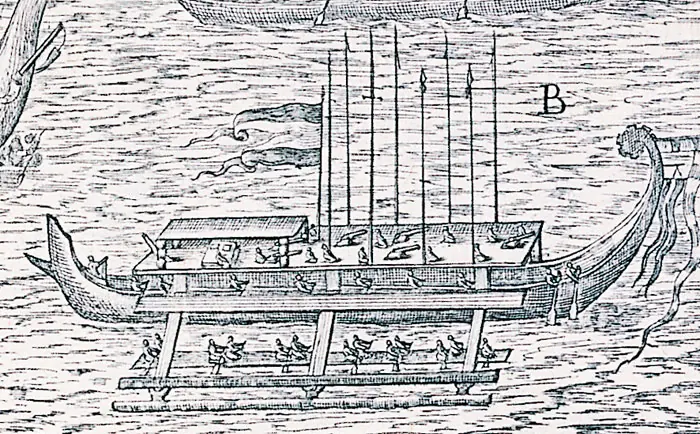
Madagascar, some 400 kilometres from the African coast, has as its language Malagasy, belonging to the South-East Barito group spoken in Borneo, at the far side of the Indian Ocean. Genetic data establish that all Malagasy populations tested carry both Bantu and Austronesian ancestry, and indicate two distinct colonisations, African and Asian, whose meeting on the island dates to about a thousand years ago. Admixture was asymmetric, as the comparison of the two uniparental transmission systems reveals: mitochondrial DNA is transmitted only through mothers, the Y chromosome only through fathers, each documenting one half of the ancestry, and their divergence indicates a different contribution by men and women according to origin. Asian ancestry is better represented in maternal lineages and inland. The vocabulary is predominantly Austronesian, whereas the genome is so only to about a third on average.
Why it matters
The gap between the area of settlement and the area of linguistic origin is among the widest documented, and presupposes transoceanic navigation. The case further shows the speed at which a regional genetic structure can form, a few centuries having sufficed to differentiate the regions of the island. Language, genome and archaeology each document a distinct part of the process.
Dating & uncertainty
Genome-wide data on 2,704 Malagasy record recent admixture and demographic growth, compatible with rapid settlement during the last millennium; the date retained corresponds to that beginning. Earlier visits are debated in archaeology, the date retained being that of settlement and not of first contact. The genomic configuration supports the hypothesis of two distinct colonisations meeting on the island rather than the arrival of an already admixed population.
Our species’ history as one day
23:55:184 min 41 s before midnight
if the 315,000 years of Homo sapiens were compressed into a single day