ENVIRONMENT × TECHNOLOGY
The Age of Plastics
~1950 CE
History · Contemporary · Holocene · Meghalayan
Synthetic plastics entered mass production around 1950 and replaced other materials in packaging, textiles, construction and medicine, in what is called the Great Acceleration.
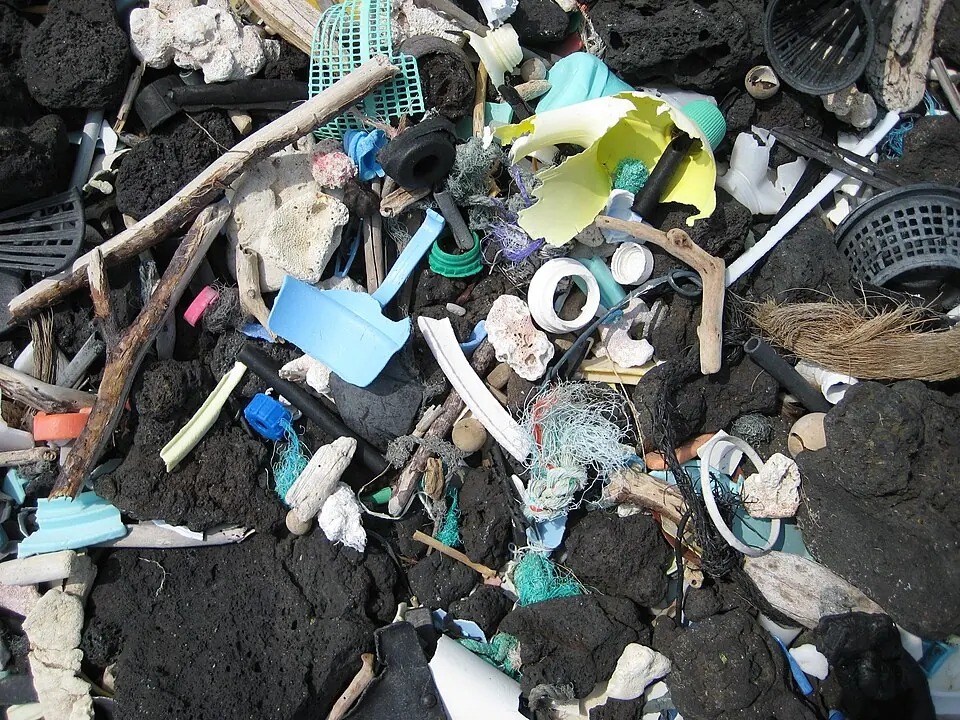
Synthetic plastics, known since the beginning of the twentieth century, enter mass production around 1950, a period designated in the environmental literature as the Great Acceleration, and substitute for numerous materials in packaging, textiles, construction and medicine. The global accounting established since that date gives about 8,300 million tonnes of virgin plastic produced up to 2015, more than three quarters of which had already become waste, with a recycling rate of nine per cent. In 2010 alone, 5 to 13 million tonnes were transferred to the ocean from coastal countries.
Why it matters
The persistence of these materials follows from their structure: they are long carbon chains without natural equivalent, for which no organism has developed an enzymatic tool of degradation, evolution not having had the time. Not metabolised, they do not decompose but fragment indefinitely into smaller particles. The property that founded their industrial utility thus determines their accumulation, now documented from the Mariana Trench to the human placenta, and geologists retain them as a stratigraphic indicator of the Anthropocene.
Dating & uncertainty
Mass production begins around 1950. Of the 6,300 million tonnes already become waste by 2015, 9 per cent were recycled, 12 per cent incinerated and 79 per cent accumulated in landfill or in the environment.
Our species’ history as one day
23:59:3920.8 s before midnight
if the 315,000 years of Homo sapiens were compressed into a single day