SOCIETY × ENVIRONMENT
Cahokia: the Mississippian City
~1050 CE
History · Middle Ages · Holocene · Meghalayan
Cahokia, on the Mississippi opposite St. Louis, grew around 1050 into the largest pre-Columbian settlement north of Mexico.
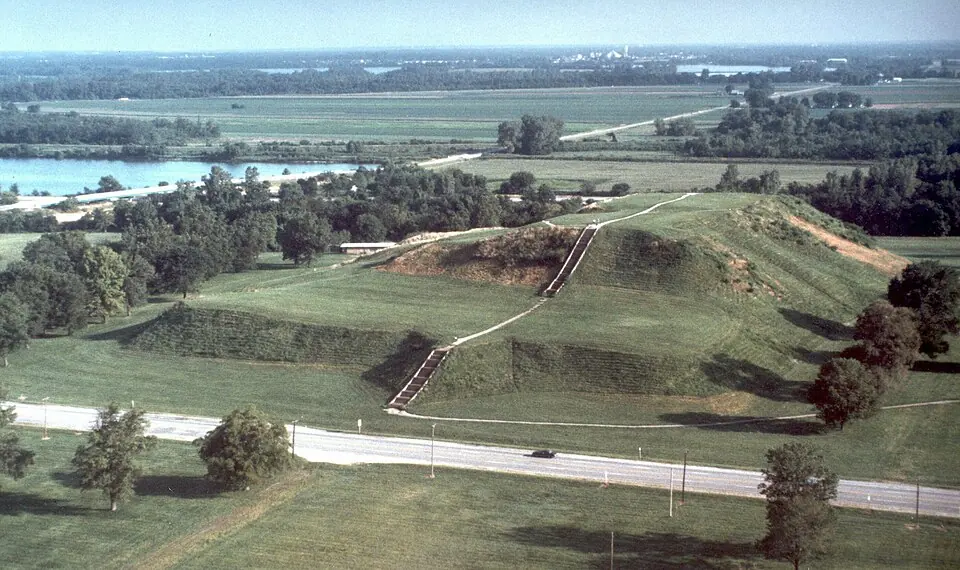
Cahokia, on the Mississippi floodplain opposite present-day St. Louis, inscribed as a World Heritage site in 1982, is the largest known pre-Columbian settlement north of Mexico. It is built to an overall plan around 1050: earthen mounds disposed around plazas, maize cultivation and a concentration of several thousand inhabitants. The largest mound, Monks Mound, occupies at its base an area greater than that of the Great Pyramid of Giza. The settlement develops during a phase of rare major floods; drought sets in from 1150, a palisade is erected, and the population had halved by about 1200. Major floods resume after 1200 and the region is abandoned around 1350.
Why it matters
North America had a settlement of urban dimension five centuries before the arrival of Europeans on the Mississippi, which contradicts the representation of a territory without dense occupation before colonisation. The trajectory of the site is today documented by a set of indicators, dendrochronological, sedimentary and molecular, and joins the comparable dossiers of the Maya region and Angkor on climatic constraints exerted on ancient cities.
Dating & uncertainty
The centre of Cahokia is built around 1050, during one of the wettest half-centuries of the millennium. Decline begins around 1150, between drought and flooding; a palisade of twenty thousand logs is raised around Monks Mound and the grand plaza, interpreted as an index of tension, and the region is abandoned around 1350. Demographic monitoring is now established through faecal stanols: the human gut produces specific molecules released in faeces, transported by runoff to the neighbouring lake and preserved in the sediments, their abundance by layer varying with the number of inhabitants of the catchment.
Our species’ history as one day
23:55:324 min 28 s before midnight
if the 315,000 years of Homo sapiens were compressed into a single day