SOCIETY
Great Zimbabwe
~1300 CE
History · Middle Ages · Holocene · Meghalayan
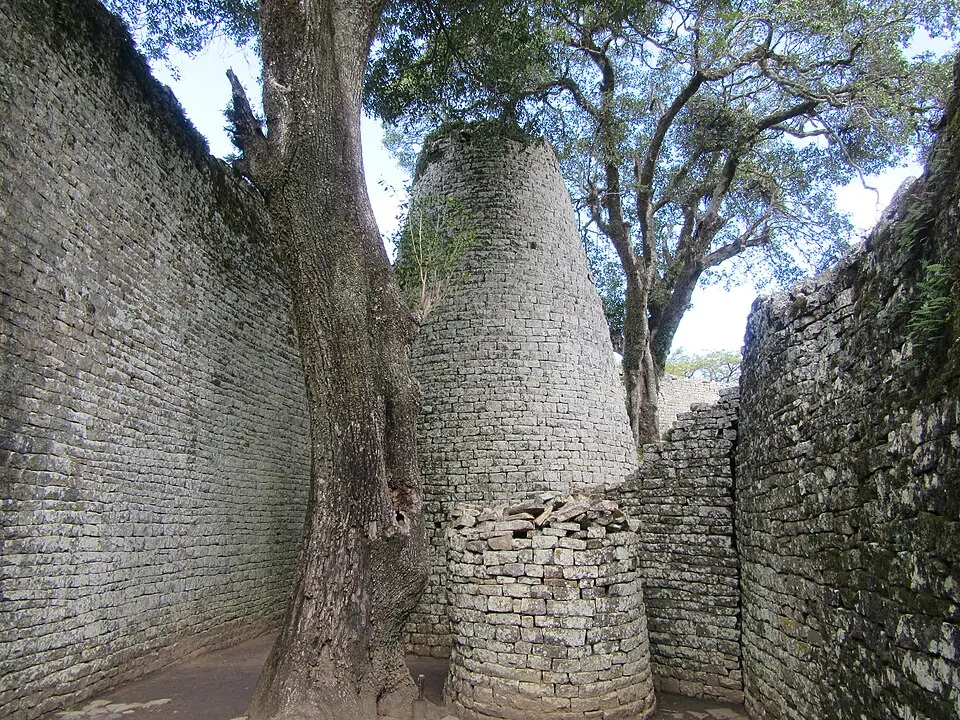
Great Zimbabwe, occupied from the twelfth to the sixteenth century, is the largest stone architecture in Africa south of Egypt, with walls eleven metres high.
Great Zimbabwe is a monumental complex on the Zimbabwe plateau, occupied between the twelfth and sixteenth centuries, constituting the largest stone architecture in Africa south of Egypt; the state that gained independence in 1980 took its name. Its walls, eleven metres high, delimit the spaces of a power founded on cattle raising and on the trade in gold and ivory conveyed to the Swahili coast. The construction is dry stone, that is, without mortar: each granite block is dressed to rest on the courses below, stability resulting from weight and friction alone, which requires controlled distribution of loads. The economy of the site depended on the Indian Ocean exchange system, linking the Persian Gulf, India and China, and its decline is related to the displacement of those commercial circuits.
Why it matters
The attribution of the site was, in the colonial period, the object of systematic denials aimed at excluding its African origin, and the archaeological work establishing that origin was subject to political pressure. The dossier further documents the integration of southern Africa into the Indian Ocean exchange networks in the medieval period.
Dating & uncertainty
Mapungubwe, in the Limpopo valley, precedes the complex between about 1000 and 1300; Great Zimbabwe develops from about 1100 to 1550, the date retained corresponding to its fourteenth-century peak. Several causes of decline have been proposed; the one retained here favours the displacement of the gold and ivory circuits in the Indian Ocean, on which the economy of these polities depended.
Our species’ history as one day
23:56:403 min 19 s before midnight
if the 315,000 years of Homo sapiens were compressed into a single day