PEOPLING × TECHNOLOGY
L'Anse aux Meadows: the Norse in America
1021 CE
History · Middle Ages · Holocene · Meghalayan
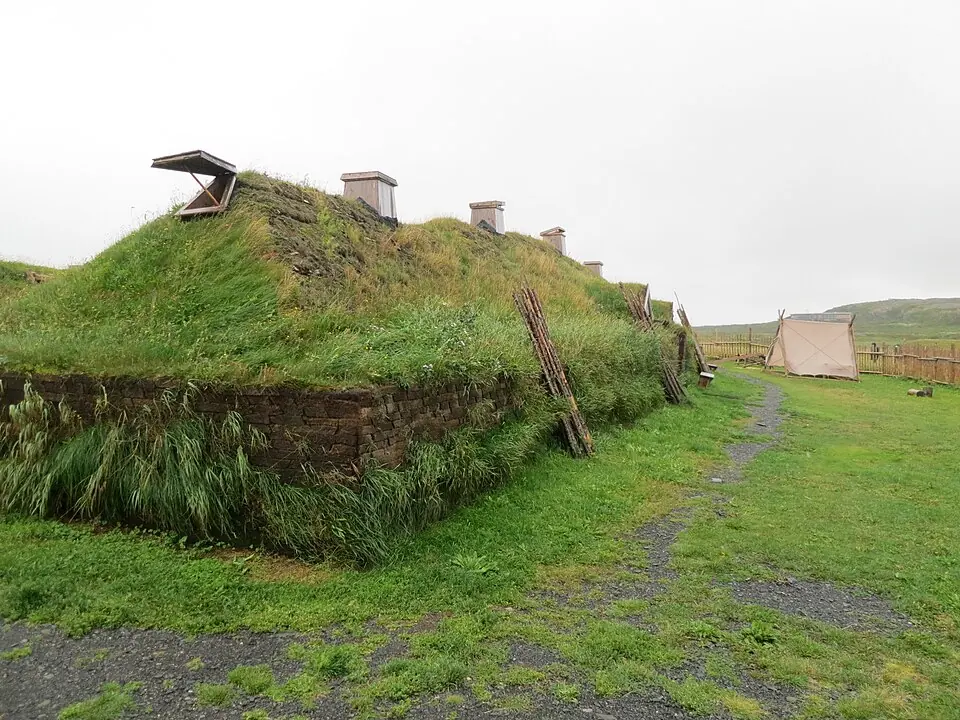
At L'Anse aux Meadows, in Newfoundland, Norse settlers felled trees with metal blades in the year 1021, at the only Norse settlement recognised in North America.
L'Anse aux Meadows, at the northern tip of Newfoundland, inscribed as a World Heritage site in 1978, is the only recognised Norse settlement in North America. Trees were felled there with metal blades in the year 1021, a date established to the year. The procedure rests on a solar particle storm that occurred in 993, which produced in the upper atmosphere a surplus of carbon-14 assimilated by plants from the following season: the year stands out as a spike in the rings of all trees then living, and it then suffices to count the rings to the bark, the last corresponding to the year of felling. The settlement constitutes the first firmly dated European presence in the Americas.
Why it matters
The crossing of the Atlantic was therefore achieved five centuries before the voyages of Columbus, then abandoned without lasting consequence. The date further provides the earliest established moment at which the settlement movements departing from Africa eastward and westward rejoin. The method employed, based on a solar event dated to the year, provides archaeology with a precision ordinary radiocarbon does not attain.
Dating & uncertainty
The cosmic ray influx of 993 enriched in radiocarbon all trees then growing; counting the rings from that marker to the bark of the worked wood gives 1021. The duration of the occupation remains less precise: earlier radiocarbon dates cover a few decades around the year 1000, and a Bayesian reanalysis does not exclude a presence extending over a century.
Our species’ history as one day
23:55:244 min 36 s before midnight
if the 315,000 years of Homo sapiens were compressed into a single day