TECHNOLOGY × SUBSISTENCE
The Heavy Mouldboard Plough
~1000 CE
History · Middle Ages · Holocene · Meghalayan
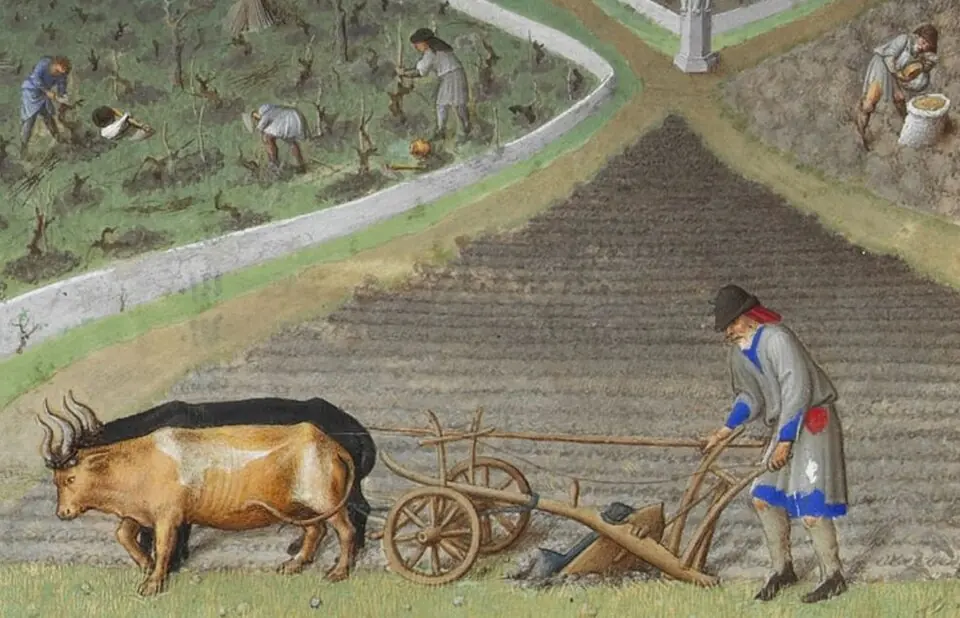
The heavy mouldboard plough, which turns the sod, opened the wet clay soils of northern Europe to farming around 1000, where the Mediterranean ard could not.
The heavy mouldboard plough is a tillage implement comprising a coulter, a share and a mouldboard that turns the sod, mounted on wheels. It permits the working of the heavy wet clay soils of northern Europe, which the Mediterranean ard, which merely opens a furrow without turning, could not exploit. Its diffusion occurs towards the end of the first millennium. Its effect has been estimated by a natural experiment design: regions otherwise comparable but differing in their soil substrate are compared before and after adoption, the soil map being determined by geology and not by human decision, which removes the risk of reversing causality. Regions of fertile clay record faster demographic and urban growth, the plough accounting for about a tenth of the rise of the High Middle Ages.
Why it matters
The implement contributed to shifting Europe's economic centre of gravity from the Mediterranean to the northern plains, where the powers of the following centuries would form. Agrarian organisation itself, nucleated villages, open fields in strips and collective ox teams, reorganises around the constraint imposed by an implement long to manoeuvre.
Dating & uncertainty
The breakthrough of the heavy plough occurs towards the end of the first millennium. The test is econometric: regions of fertile clay, inaccessible to the ard, urbanise and grow faster after adoption, the effect attributed to the plough being established at about a tenth of the urban and demographic growth of the High Middle Ages. Bioarchaeology now tests directly the crop rotations and the extension of cultivated area associated with it. The undulations known as ridge and furrow, left by this mode of ploughing, remain visible in English pastures.
Our species’ history as one day
23:55:184 min 41 s before midnight
if the 315,000 years of Homo sapiens were compressed into a single day