CLIMATE × EARTH
The Freezing of Antarctica
~34 million years ago
Phanerozoic · Cenozoic · Paleogene · Eocene
Atmospheric carbon dioxide fell, about 34 million years ago, below the level at which ice can survive an Antarctic summer, and an ice sheet spread across the continent in about eight hundred thousand years.
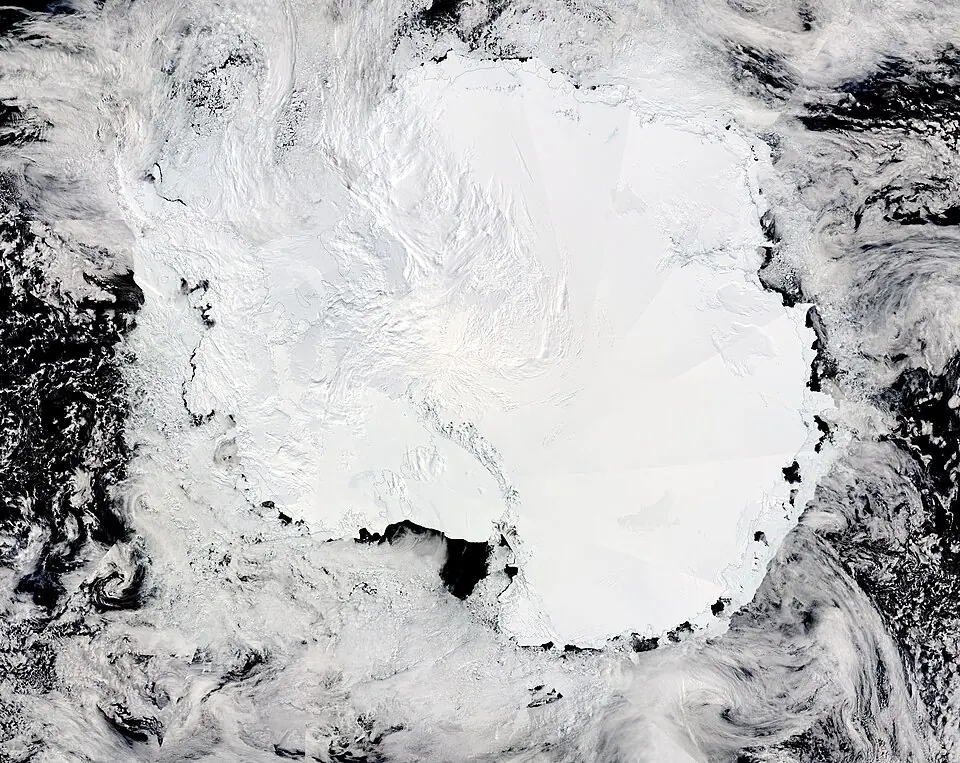
The freezing of Antarctica is the growth of an ice sheet, a mass of ice that covers land, at the Eocene-Oligocene boundary, the limit between two geological epochs. Carbon dioxide fell below the level at which ice can survive an Antarctic summer, and the ice sheet spread across the continent in about eight hundred thousand years. This level depends on summer melting rather than winter cold: ice accumulates only where less melts in summer than falls as snow in winter. The world passed from a greenhouse state, with no permanent ice, into the icehouse state, with permanent ice, which continues today.
Why it matters
Every event after the freezing of Antarctica takes place on a planet with one pole already glaciated. Each of the ice ages through which our species evolved is an oscillation within the icehouse state that began then. The carbon now being released is returning the climate towards the carbon dioxide level that was crossed when Antarctica froze.
Dating & uncertainty
The freezing lasted about 790,000 years. Researchers read it in oxygen isotopes, forms of oxygen of different mass whose proportions depend on both ice volume and temperature. A fall in carbon dioxide accounts for the data better than the opening of ocean gateways, sea passages between continents, but the Earth's orbit probably determined the exact moment.
Earth history as one day
23:49:1210 min 47 s before midnight
if Earth’s 4.54 billion years were compressed into a single day