EARTH × CLIMATE
The Tibetan Plateau and the Monsoon
~40 to 10 million years ago
Phanerozoic · Cenozoic · Paleogene · Eocene
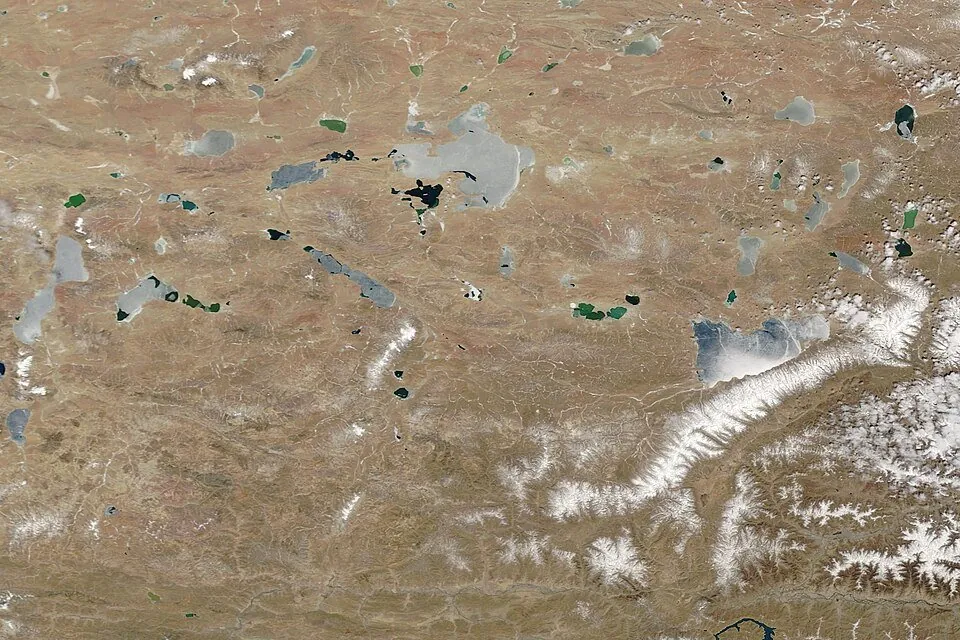
India drove into Asia and raised the Tibetan plateau, an area the size of western Europe five kilometres high, and the plateau is held to have strengthened the monsoon between 40 and 10 million years ago.
The monsoon is a wind regime that brings moist oceanic air, and its rain, over the land in summer. Its cause is the difference of temperature between land and ocean, called the thermal contrast: in summer the land heats far faster than the sea beside it, the heated air rises, and moist oceanic air is drawn inland in its place. The collision of India with Asia raised the Tibetan plateau, an area the size of western Europe standing five kilometres above sea level. Geologists read three pulses of uplift in the rocks, and a strengthening of the winds is associated with these pulses. The uplift also laid bare fresh rock, which may have removed carbon dioxide from the air as it weathered, that is as water altered it chemically.
Why it matters
The Tibetan plateau and the monsoon are the textbook case of a climate determined by tectonics, the movement of the plates that form the Earth's surface. The case is not settled. The data do not yet establish whether the plateau created the monsoon or intensified a circulation of air that already existed. Half the world's population now depends on the rain that the Asian monsoon delivers.
Dating & uncertainty
The three pulses of uplift are dated around 40 to 35, 25 to 20 and 15 to 10 million years ago. Only the middle pulse is accompanied by satisfactory climatic evidence. The oldest pulse cannot be tested for want of data. The most recent pulse falls within a phase of global cooling and Antarctic glaciation, which could have moved the monsoon by itself. No rock records the birth of a wind regime. Which pulse generated the monsoon, and the respective shares of the plateau and of falling carbon dioxide, are therefore taken from climate models and not from field evidence.
Earth history as one day
23:47:1812 min 41 s before midnight
if Earth’s 4.54 billion years were compressed into a single day