LIFE × CLIMATE
C4 Grasses and the Grasslands
~10 to 3 million years ago
Phanerozoic · Cenozoic · Neogene · Miocene
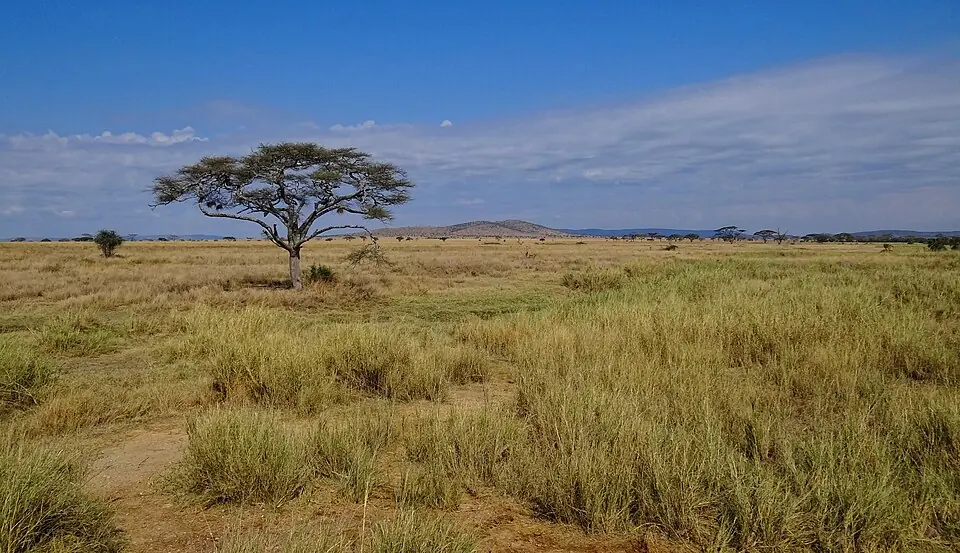
Tropical grasses using the C4 pathway of photosynthesis, which is less wasteful when carbon dioxide is scarce and temperatures are high, took over the warm continents between 10 and 3 million years ago, and woodland gave way to savannah.
C4 is a pathway of photosynthesis that tropical grasses evolved. The ordinary pathway relies on Rubisco, an enzyme, that is a protein that speeds up a chemical reaction. Rubisco fixes carbon dioxide: it binds the gas into the organic molecules of the plant. Rubisco also reacts with oxygen, which is a wasteful loss for the plant, and the loss grows as carbon dioxide becomes scarce and temperatures rise. C4 plants concentrate carbon dioxide around Rubisco before the enzyme acts, which suppresses that loss. Between roughly ten and three million years ago C4 grasses took over the warm continents. Woodland gave way to open savannah as fire seasons lengthened.
Why it matters
Researchers have long held that hominins, the members of the human lineage, became walkers and then hunters in open environments. The date at which C4 grasses spread therefore matters for the study of hominin evolution. The arrival of C4 grasses and their predominance are dated separately, and it is when C4 grasses became dominant that woodland gave way to open savannah.
Dating & uncertainty
C4 grasses became ecologically dominant, that is the main component of the vegetation, between about 10 and 3 million years ago. In East Africa, Peppe and colleagues (2023) found C4 grasses locally abundant as early as 21 million years ago, which is now their oldest known trace. That older date leaves the date of their predominance unchanged.
Earth history as one day
23:56:493 min 10 s before midnight
if Earth’s 4.54 billion years were compressed into a single day