EARTH × EXTINCTIONS
The Deccan Traps
~66 million years ago
Phanerozoic · Mesozoic · Cretaceous
The Deccan Traps, a volcanic province in India, erupted more than a million cubic kilometres of lava around the end of the Cretaceous, in four pulses, at least one beginning tens of thousands of years before an asteroid struck the Earth.
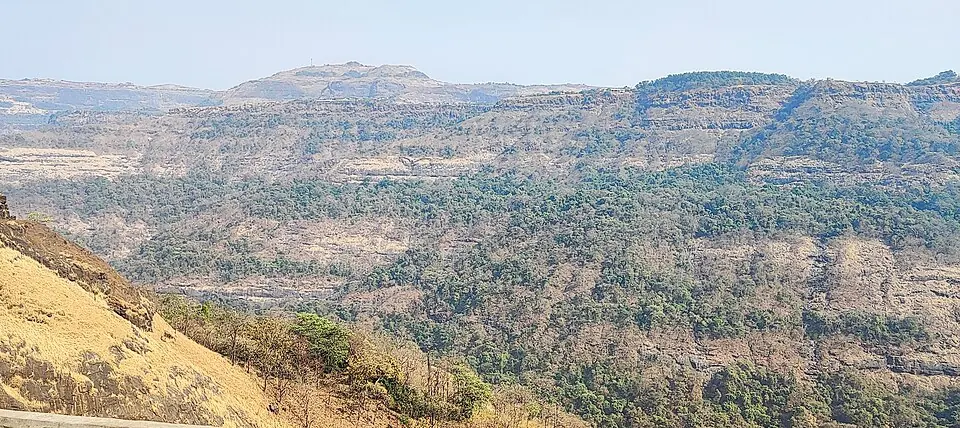
The Deccan Traps are a flood basalt province in India, a region buried under stacked flows of basalt, a dark volcanic rock. More than a million cubic kilometres of lava erupted there across the end of the Cretaceous, the geological period that closes with a mass extinction and an asteroid impact. The lava came in four high-volume pulses, and at least one began tens of thousands of years before the impact. Studies of the carbon cycle, the movement of carbon between rock, ocean and air, follow the gases rather than the lava. In these studies the principal outgassing starts and finishes distinctly before the impact. Outgassing is the release of carbon dioxide and sulfur from the magma, the molten rock that feeds the eruptions. Only the impact coincides with the extinction itself. The eruptions and the impact are both dated, and how much each contributed to the extinction remains at issue.
Why it matters
The eruptions and the asteroid impact are two plausible causes of the mass extinction, and they acted within the same few tens of thousands of years. Palaeontologists therefore have to work out what each of the two did. The two may have acted in opposite directions. The disappearance of a large part of the biosphere, the whole of living things, let the ocean absorb far more carbon dioxide than usual. This absorption would have attenuated the warming the eruptions should have produced.
Dating & uncertainty
Uranium-lead and argon-argon dating both measure the radioactive decay of one element into another in the rock. The two methods agree that the eruptions straddle the Cretaceous-Palaeogene boundary, the limit between those two geological periods, but diverge on which pulses preceded the asteroid. The share of the extinction attributable to volcanism remains openly contested.
Earth history as one day
23:38:5821 min 2 s before midnight
if Earth’s 4.54 billion years were compressed into a single day