EXTINCTIONS × TECHNOLOGY
The Iridium Layer at the K-Pg Boundary
1980 CE
Phanerozoic · Cenozoic · Quaternary · Holocene · Meghalayan
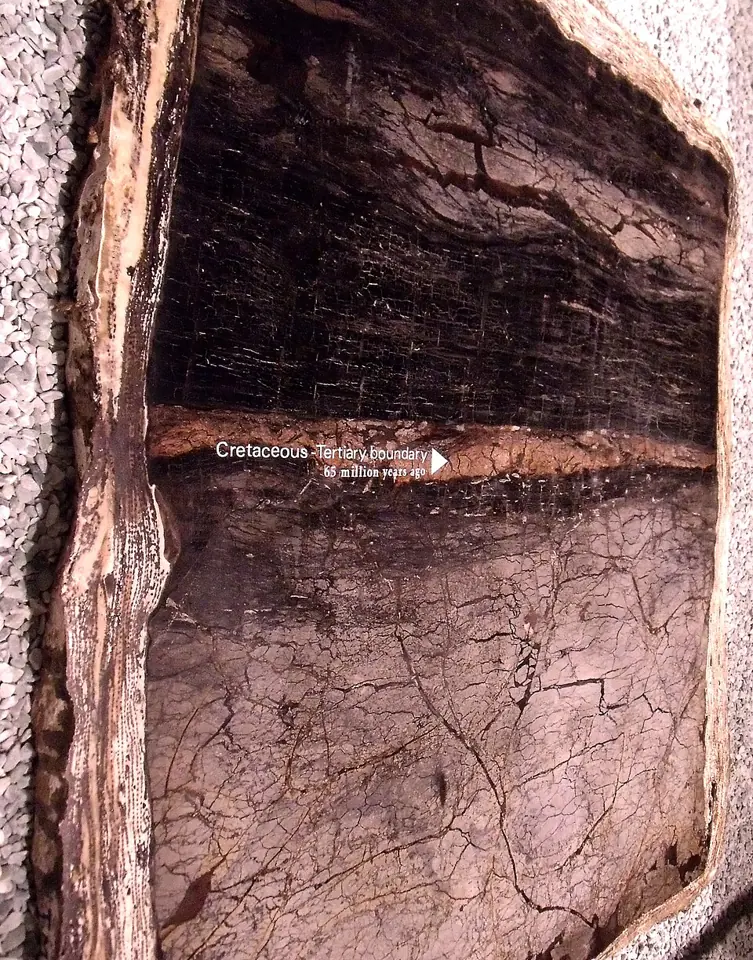
A centimetre of clay at the Cretaceous boundary, where that period's rocks end, is tens to hundreds of times richer than the rock around it in iridium, a metal scarce in the Earth's crust and common in meteorites, as reported in 1980.
The iridium layer is a centimetre of clay at the Cretaceous boundary. The clay contains tens to hundreds of times more iridium than the rock immediately above and below it. Iridium is scarce in the Earth's crust, because it sank with the iron into the core, and common in material arriving from space. In 1980 Luis and Walter Alvarez proposed that a mass extinction, the disappearance of many species in a short time, had a single sudden cause of extraterrestrial origin. The proposal met resistance, because geology was committed to uniformitarianism. Uniformitarianism is the principle that the past is to be explained by processes observable today, and geologists had read it as excluding catastrophes. Eleven years later a crater that matched the proposal was located in Mexico.
Why it matters
Geologists once more admitted catastrophe as an explanation. Many entries on this timeline name a sudden cause, whether an impact, an eruption or a flood. Explanations of that kind came back into use in geology because of this centimetre of clay.
Dating & uncertainty
The year 1980 is the year of the hypothesis, not of its acceptance. For eleven years the hypothesis rested on chemistry alone, the iridium measured in the clay, and no crater was tied to it. The identification of a crater in Mexico then turned a contested proposal into the standard account.
Earth history as one day
23:59:59.9991875 µs before midnight
if Earth’s 4.54 billion years were compressed into a single day