GENETICS × TECHNOLOGY
The Polymerase Chain Reaction
1983 to 1985 CE
Phanerozoic · Cenozoic · Quaternary · Holocene · Meghalayan
The polymerase chain reaction, devised between 1983 and 1985, is a method that doubles a chosen stretch of DNA at each cycle of heating and cooling and so makes a great many copies from a trace of DNA.
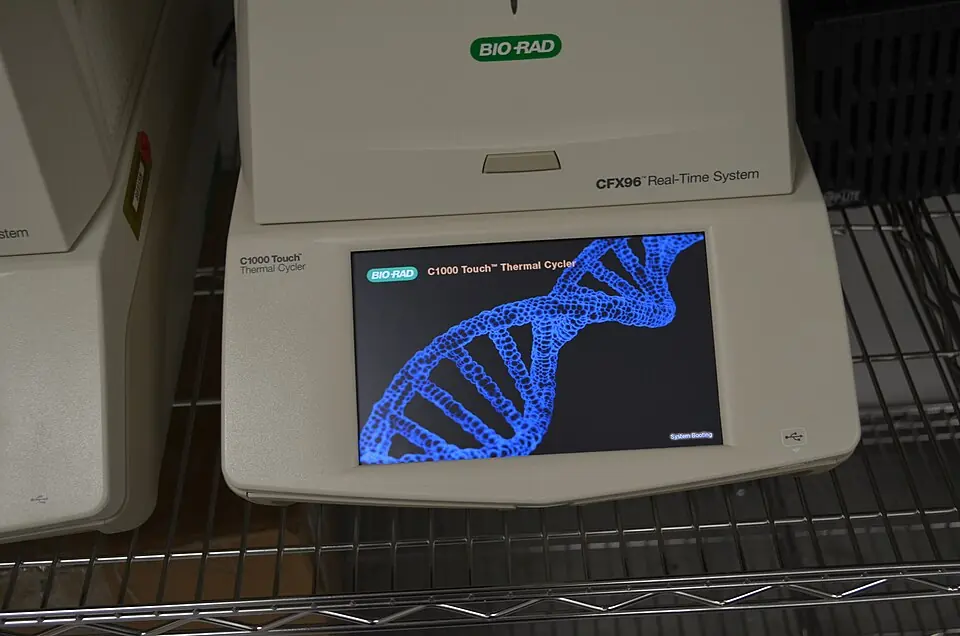
The polymerase chain reaction copies a chosen stretch of DNA in repeated cycles. Heat first separates the two strands of the DNA molecule. Cooling then lets primers, short pieces of DNA that mark where copying starts, settle on the stretch to be copied. An enzyme called a polymerase copies the stretch, then the heat returns and the cycle begins again. Each cycle doubles the number of copies, so one molecule becomes a billion within an afternoon. The method became routine only with Taq polymerase, a polymerase taken from a bacterium of hot springs. Taq polymerase survives the heating step, so it does not have to be replaced at every cycle.
Why it matters
Ancient bones, a crime scene, a virus on a nasal swab: each contains DNA in quantities far below the amount needed to read its sequence. The polymerase chain reaction multiplies that DNA until it can be read. Several of the discoveries placed further along this timeline were made only because of this method.
Dating & uncertainty
The two dates are those of the conception, in 1983, and of the first published application, by Saiki and colleagues, in 1985. Taq polymerase, which made the method routine, came two years after that application.
Earth history as one day
23:59:59.9992818 µs before midnight
if Earth’s 4.54 billion years were compressed into a single day