GENETICS × EVOLUTION
The Archaea: a Third Domain
1977 CE
Phanerozoic · Cenozoic · Quaternary · Holocene · Meghalayan
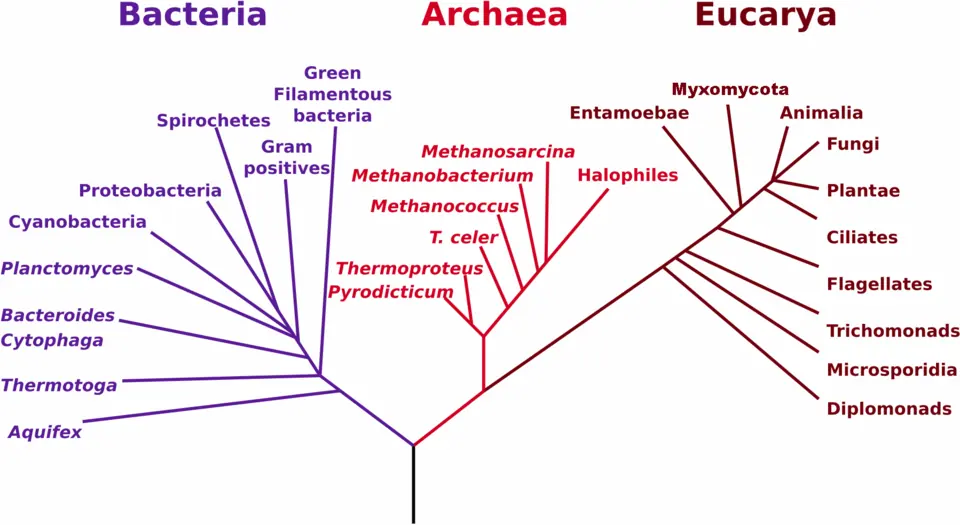
The archaea are microbes that Woese and Fox recognised in 1977 as a third domain of life, distinct from bacteria, by comparing one molecule present in every living thing, the 16S ribosomal RNA.
The archaea are microbes that form one of the three domains of life, the broadest divisions in the classification of living things. Woese and Fox (1977) identified them by comparing a single molecule, the 16S ribosomal RNA, a component of the ribosome, which builds proteins in cells. The molecule serves as a universal standard of comparison because every living thing has it, it performs the same function in all of them, and it changes slowly enough to keep the trace of ancient divergences between groups of organisms. The microbes that had been classified together as bacteria proved to contain a second group, as distant from bacteria as we are. Life therefore has three domains rather than two. The new domain, the archaea, had been in the collections all along, classified as bacteria.
Why it matters
Everything that precedes animals is placed according to this classification. The classification also directed the search for the origin of the complex cell, the cell of eukaryotes. Once the archaea were a distinct group, the position of the ancestor of eukaryotes could be determined. Phylogenomics, the comparison of whole genomes, has since placed that ancestor among the archaea.
Dating & uncertainty
The year 1977 is that of the publication. The proposal of a third domain was contested for a decade before being accepted. The classification has since changed again, between the archaea and the eukaryotes, the group that includes ourselves: eukaryotes now appear as a branch within the archaea and not as a neighbouring group.
Earth history as one day
23:59:59.9991933 µs before midnight
if Earth’s 4.54 billion years were compressed into a single day