EARTH × TECHNOLOGY
Seafloor Spreading and Magnetic Stripes
1963 to 1968 CE
Phanerozoic · Cenozoic · Quaternary · Holocene · Meghalayan
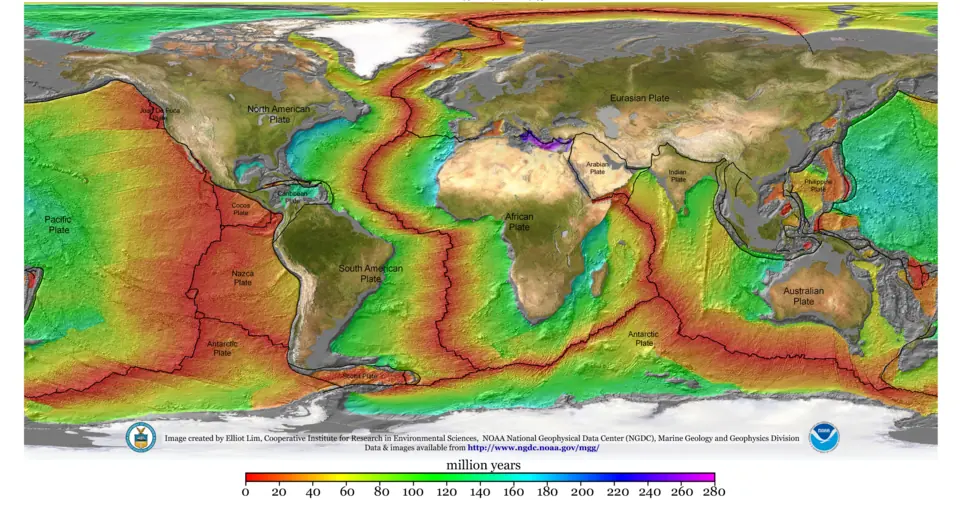
Sea-floor spreading, in which rock forms at the mid-ocean ridges and is carried away on both sides, was demonstrated between 1963 and 1968 from magnetic stripes that mirror one another on either side of those ridges.
Sea-floor spreading is the process in which rock forms at a mid-ocean ridge, an underwater mountain chain, and is carried away in both directions. Continental drift, the idea that the continents move, had been proposed fifty years before this process was demonstrated, and rejected for want of a mechanism. As basalt, the volcanic rock of the sea floor, cooled, it kept the direction of the Earth's magnetic field, which has reversed repeatedly. The sea floor therefore shows magnetic anomalies, stripes of alternating polarity, that is, of opposite magnetic direction. The stripes on either side of a ridge mirror one another. Only sea-floor spreading produces that pattern, and it was the mechanism that continental drift had lacked.
Why it matters
Geology passed from a set of regional explanations to a single theory, the theory of plates. That theory allows this timeline to describe the assembly and break-up of supercontinents, landmasses that unite most of the continents. Every date on the Earth layer of the timeline presupposes the theory.
Dating & uncertainty
Continental drift was proposed in 1912 and rejected for half a century, because no known mechanism could move the continents. In 1963 the magnetic stripes of the sea floor, symmetrical about the ridges, revealed that mechanism. The full theory of plates followed within five years.
Earth history as one day
23:59:59.99881.2 ms before midnight
if Earth’s 4.54 billion years were compressed into a single day