EARTH
Vredefort: the Largest Crater
~2.02 billion years ago
Proterozoic · Paleoproterozoic · Orosirian
The Vredefort structure, in South Africa, is the largest confirmed impact crater on Earth, some 250 kilometres wide, left by a body about twenty kilometres across that struck 2.02 billion years ago.
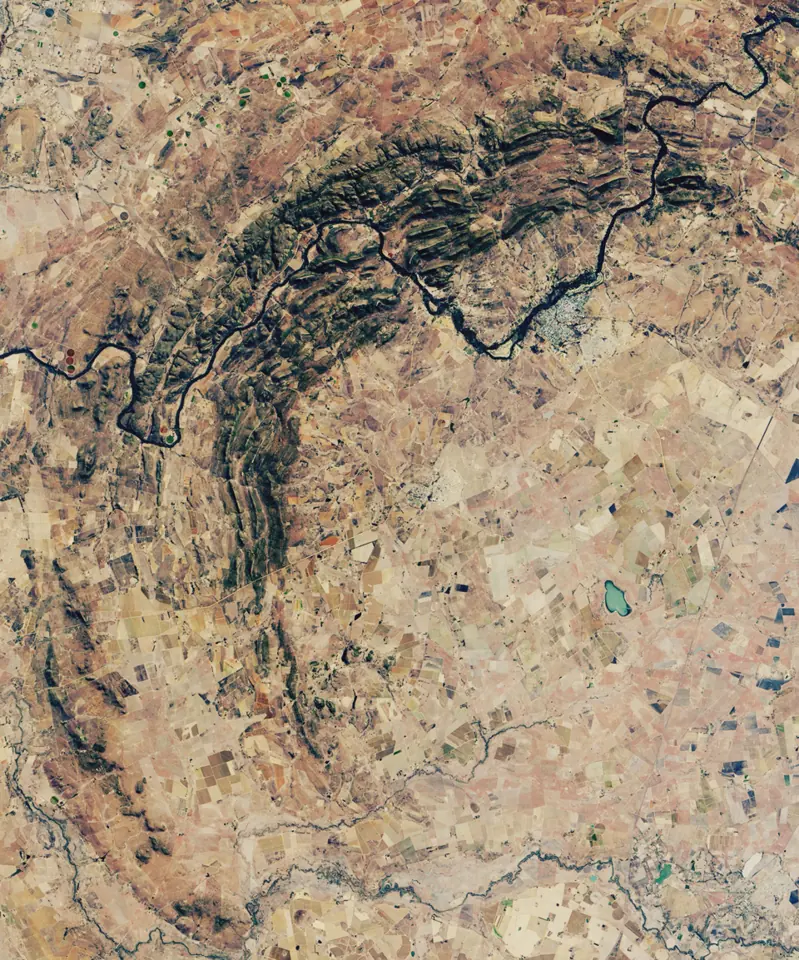
The Vredefort structure is the eroded remnant of an impact crater in South Africa. A body some twenty kilometres across struck about 2.02 billion years ago and left a crater around 250 kilometres wide, the largest confirmed on Earth. Erosion has removed the rim of the crater, and its floor is what is exposed today. This floor is rock of the deep crust that the rebound heaved upward: after a large impact, the ground behaves briefly as a fluid and surges back up at the centre. The gold of the Witwatersrand basin lies alongside the structure.
Why it matters
Chicxulub, the impact that ended the non-avian dinosaurs, meaning all dinosaurs except birds, excavated a smaller crater than Vredefort. No confirmed impact structure is larger. The early Earth sustained impacts of this size regularly and recovered from them.
Dating & uncertainty
The age of the Vredefort structure, 2.02 billion years, is well constrained, with little uncertainty. The estimate of its size has changed. The impactor, the body that struck, was long assumed to be 15 kilometres across. Allen and colleagues (2022) ran simulations that reproduce the shocked minerals, minerals deformed by the impact. These simulations require an impactor of 20 to 25 kilometres and a crater close to 250 kilometres across.
Earth history as one day
13:19:1710 h 41 min before midnight
if Earth’s 4.54 billion years were compressed into a single day