EXTINCTIONS × EARTH
The End-Triassic Extinction
~201 million years ago
Phanerozoic · Mesozoic · Jurassic
The end-Triassic extinction was a mass extinction that coincided, about 201 million years ago, with the first splitting of Pangaea, when the Central Atlantic Magmatic Province erupted in four pulses over about 600,000 years.
The end-Triassic extinction is a mass extinction that coincides with the first splitting of Pangaea, the supercontinent that joined all the continents. The rift, the fracture of the continent, filled with basalt, a volcanic rock. This basalt forms the Central Atlantic Magmatic Province, among the largest volcanic events known. The province erupted in four pulses over about 600,000 years. Bubbles trapped in the basalt, studied by Capriolo and colleagues (2020), show that at least part of its carbon dioxide came from depth, from the mantle, the layer beneath the Earth's crust, or from the lower to middle crust. They also show that each pulse lasted only a few centuries. Marine diversity fell by up to about half, and terrestrial ecosystems were overturned as well.
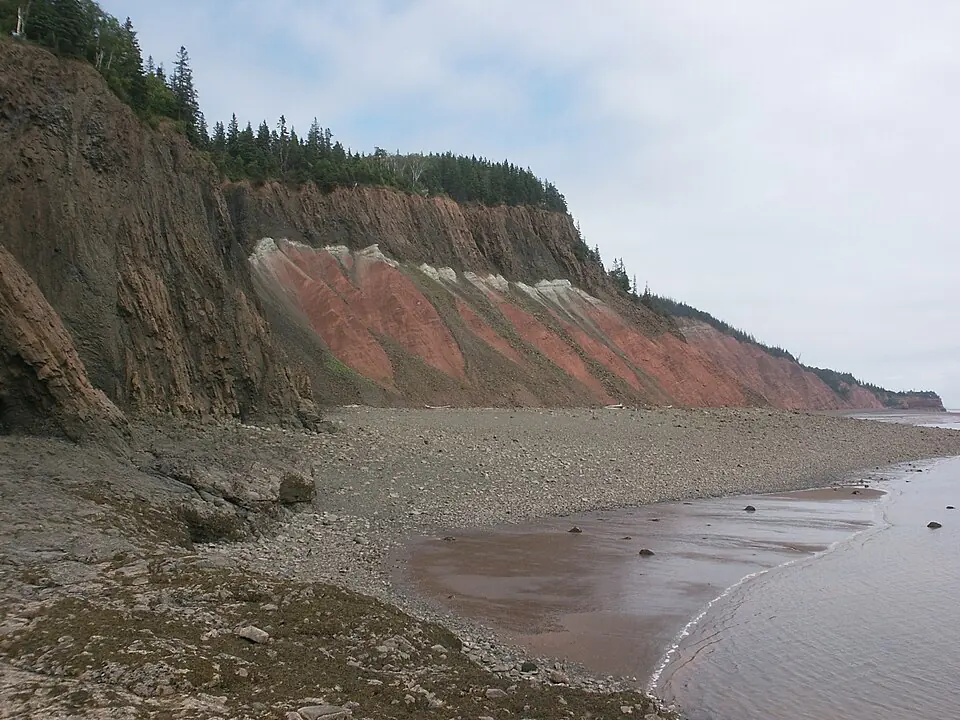
Why it matters
Each of the four volcanic pulses of the Central Atlantic Magmatic Province injected into the atmosphere a quantity of carbon dioxide comparable to the quantity that projections attribute to human activity across the whole twenty-first century. The rocks of the end-Triassic therefore record the consequences of a century of emissions of that order. Global warming followed, with ocean acidification, in which seawater becomes more acidic as it absorbs carbon dioxide. Dinosaurs were the dominant land vertebrates when the Jurassic, the period after the Triassic, began.
Dating & uncertainty
Blackburn and colleagues (2013) dated zircons, crystals whose uranium content gives an age. Their ages tie the extinction to the first pulses of the Central Atlantic Magmatic Province to within about 100,000 years. That is the maximum precision that geochronology, the science of dating rocks, currently permits for associating a cause with an effect.
Earth history as one day
22:56:071 h 4 min before midnight
if Earth’s 4.54 billion years were compressed into a single day