ATMOSPHERE × TECHNOLOGY
The Montreal Protocol and the Ozone
1985 to 2016 CE
Phanerozoic · Cenozoic · Quaternary · Holocene · Meghalayan
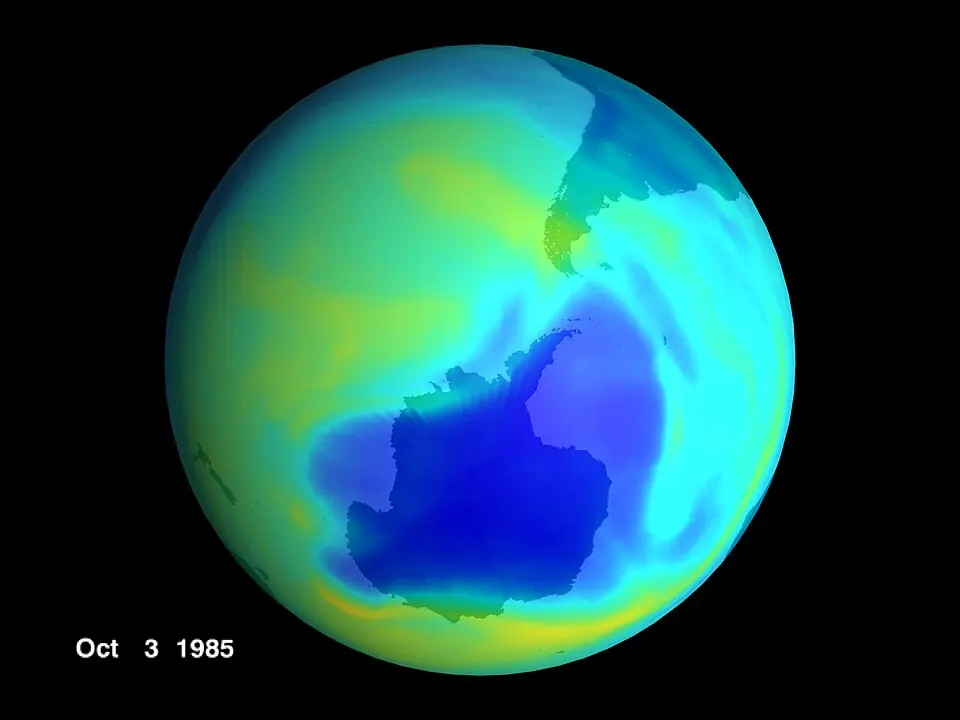
The ozone hole, found by ground observers in 1985, opens over Antarctica every southern spring in the ozone that shields the Earth's surface from ultraviolet, and is caused by chlorofluorocarbons, gases used as refrigerants.
The ozone hole is a zone of large ozone loss that opened over Antarctica every southern spring. Ozone is a gas that absorbs ultraviolet before it reaches the Earth's surface. Chlorofluorocarbons were destroying it. Ground observers detected the hole, as Farman, Gardiner and Shanklin reported in 1985. Their readings fell far outside expectation. Satellites had measured the same values, but an automated filter had discarded them as instrument error. Within two years of the detection, a treaty, the Montreal Protocol, committed the world to phasing the chlorofluorocarbons out. In 2016 Solomon and colleagues reported the first measured signs of recovery.
Why it matters
The ozone hole is the only case in which the human species observed that it was degrading one of the planet's systems, agreed to stop, and could then observe the beginning of the repair. Three decades separate the treaty from the first measured signs of recovery. That delay shows how slowly a planet responds. The case is the precedent for any discussion of carbon.
Dating & uncertainty
The dates are firm. The hole was reported in 1985 and the treaty was signed in 1987. The first statistically significant recovery, one unlikely to be due to chance, was published in 2016. The year 2016 marks the beginning of the recovery, not its completion.
Earth history as one day
23:59:59.9992780 µs before midnight
if Earth’s 4.54 billion years were compressed into a single day