TECHNOLOGY × SOCIETY
The World Wide Web
1991 CE
History · Contemporary · Holocene · Meghalayan
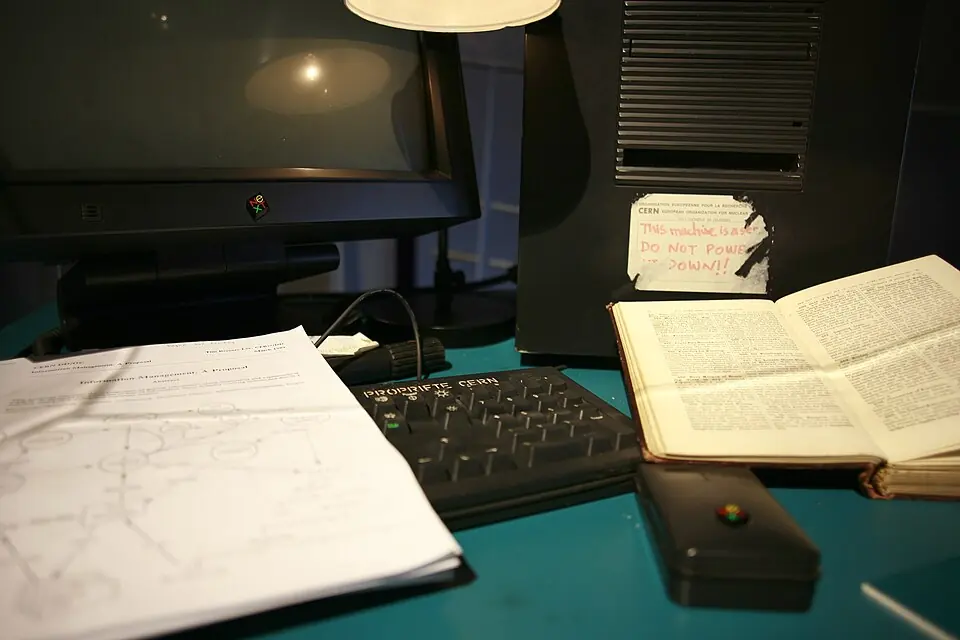
The World Wide Web, devised at CERN by Tim Berners-Lee and announced publicly in 1991, is a system of documents with universal addresses, linked to one another.
The World Wide Web is a system of documents identified by a universal address and linked to one another, devised at CERN by Tim Berners-Lee. It combines two pre-existing sets. The Internet is the transmission infrastructure, a set of technical conventions allowing distant machines to exchange packets of data, in service since the 1970s; hypertext is the principle of documents designating one another. The Web results from the attribution to each document of a universal address on that network, so that a text can designate another independently of the machine hosting it. The system rests on three specifications, the URL, the HTTP protocol and the HTML language. The proposal dates from March 1989, the first server and first browser, both named WorldWideWeb, from December 1990, the public announcement from August 1991.
Why it matters
In April 1993, CERN placed the software in the public domain, an institutional decision on which the subsequent diffusion of the system depends. The Web modified within a generation the conditions of access to information, commerce and communication, a transformation comparable in scale to that of printing. Its founding principles, universality, decentralisation and open access, follow from no technical necessity: they result from choices, which the later evolution of the network has variously respected.
Dating & uncertainty
The date retained is that of the public announcement, in August 1991. The initial proposal, addressed to CERN management in 1989, bore on document management in a physics laboratory.
Our species’ history as one day
23:59:509.6 s before midnight
if the 315,000 years of Homo sapiens were compressed into a single day