TECHNOLOGY × SOCIETY
The Shipping Container
1956 CE
History · Contemporary · Holocene · Meghalayan
In April 1956, a converted tanker left Newark with the first shipping containers, metal boxes that move between ship, train and lorry without their contents being handled.
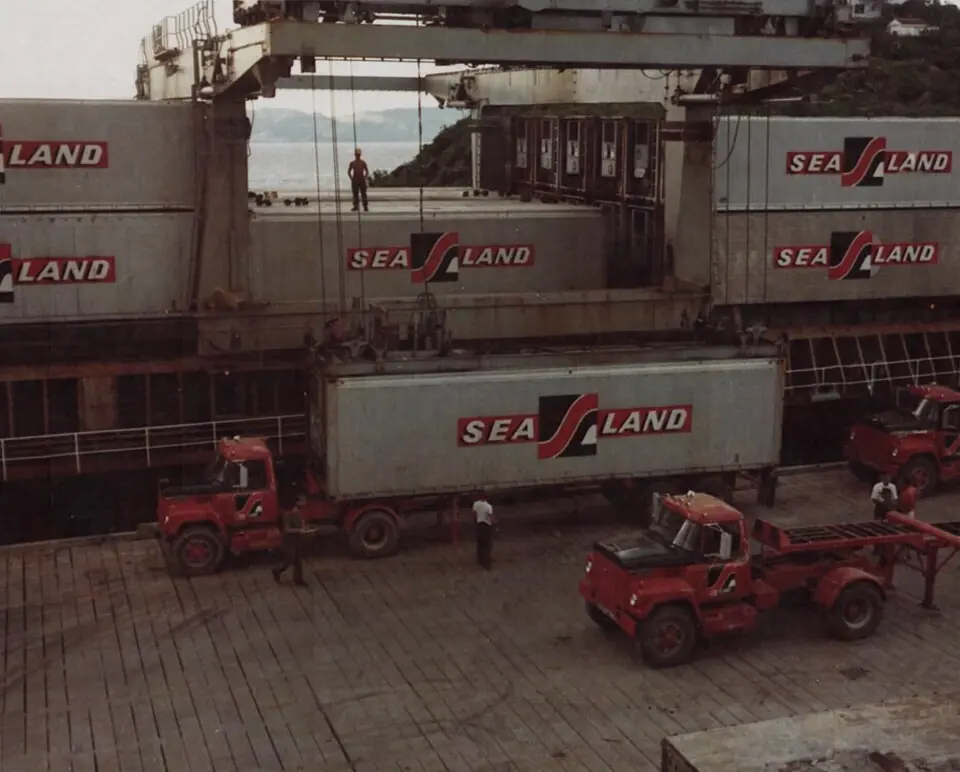
Containerisation is the organisation of freight transport in standardised metal boxes, transferable between ship, train and lorry without handling the contents. The inaugural voyage takes place in April 1956, the Ideal X, a tanker converted by the road haulier Malcom McLean, leaving Newark with fifty-eight aluminium boxes on deck. The principle lies in what it removes: until then, each sack, case or barrel passed from hand to hand between hold, quay and lorry, and a ship remained longer alongside than at sea; a sealed container moves in a single crane lift and is not reopened between factory and destination, which removes both the days of immobilisation and the losses in transit. Standardisation of dimensions allowed ship, train and lorry to be treated as a single system.
Why it matters
Econometric estimates attribute to containerisation a fall of about a fifth in variable transport costs and a rise in trade between industrialised countries close to 700 per cent over twenty years, an effect greater than that of the trade agreements of the same period. Long-distance supply chains, and the industrial specialisation they permit, presuppose this fall in the cost of distance. The transformation moreover eliminated dock labour in the older ports and displaced activity towards new terminals.
Dating & uncertainty
The Ideal X makes the Newark-Houston voyage in April 1956. The economic figures are estimates established from the timing of adoption and not from direct measurement.
Our species’ history as one day
23:59:4019.2 s before midnight
if the 315,000 years of Homo sapiens were compressed into a single day