SOCIETY
The Inca Empire
~1470 CE
History · Middle Ages · Holocene · Meghalayan
The Inca Empire, the Tawantinsuyu, was the largest pre-Columbian state of the Americas, stretched over four thousand kilometres of the Andes and run with knotted cords, the khipus.
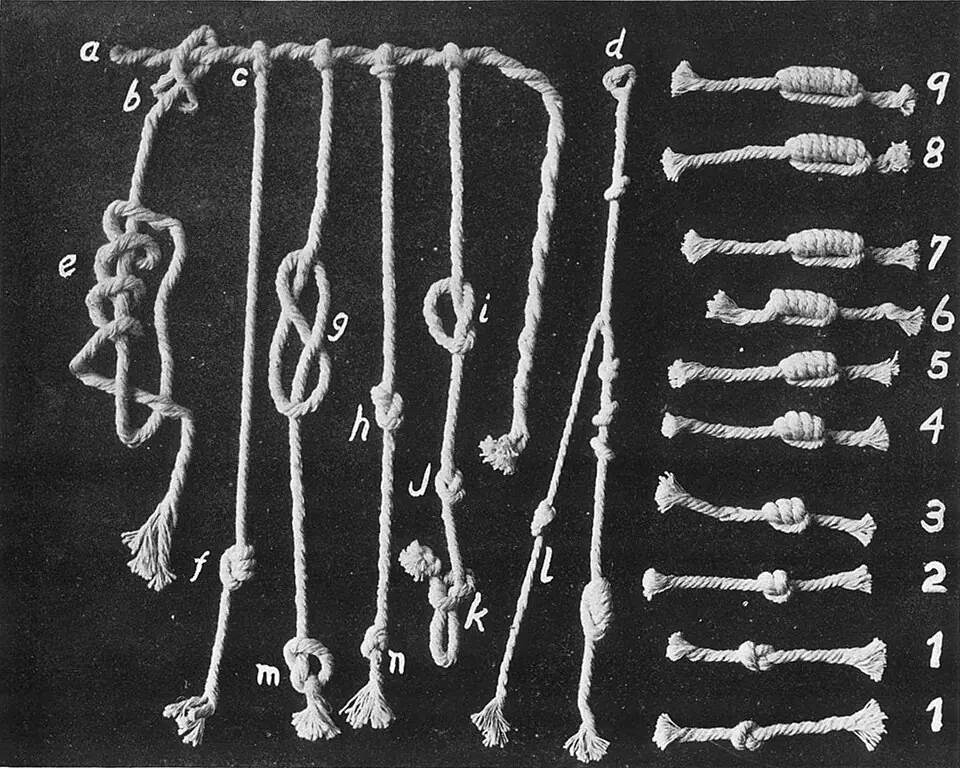
The Tawantinsuyu, whose Quechua name means the four regions united, is the largest pre-Columbian state in the Americas, extended over four thousand kilometres along the Andes. Its administration, bearing on stores, censuses and labour obligations, rests on khipus, assemblies of knotted cords. Their coding constitutes a notation in its own right: the position of the knot along the cord indicates the decimal rank, units, tens or hundreds, and the number of turns indicates the digit, which makes it a place-value numeral system realised in fibre. Circulation uses the Qhapaq Nan, a network of about forty thousand kilometres of routes, inscribed as a World Heritage site in 2014, provided with bridges, runner relays and waystations. The whole was built and administered without writing in the usual sense.
Why it matters
The association commonly posited between state formation and writing does not hold here: bureaucracy, taxation and territorial administration rest on a data support that decipherment has not entirely restored. The road network further sustains comparison with Roman infrastructure. Provincial archaeology finally shows local populations diverting that network to their own ends, which qualifies the image of homogeneous centralised control.
Dating & uncertainty
The Tawantinsuyu attains its maximum extent in the century preceding 1532, from southern Colombia to central Chile; the date retained corresponds to that peak. Provincial archaeology documents heterogeneous and negotiated control, and mining communities used the imperial route for their own trade.
Our species’ history as one day
23:57:272 min 33 s before midnight
if the 315,000 years of Homo sapiens were compressed into a single day