HEALTH × ENVIRONMENT
The Columbian Exchange
1492 CE
History · Middle Ages · Holocene · Meghalayan
From 1492, plants, animals and diseases crossed the Atlantic in both directions: maize and potato eastward, wheat, horses, cattle and above all pathogens westward.
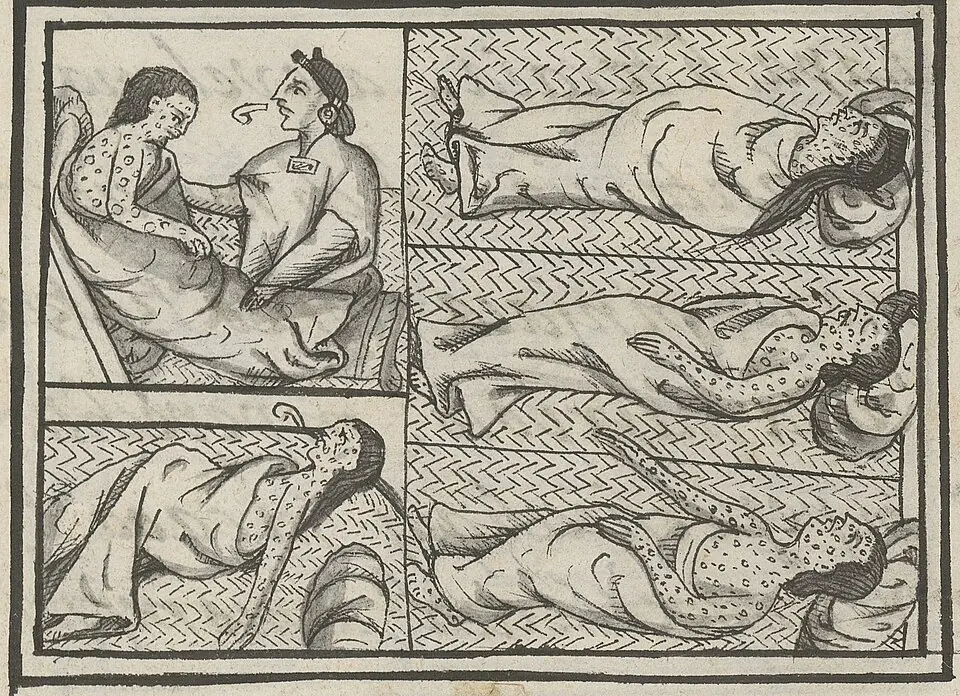
The Columbian exchange, a term coined by the historian Alfred Crosby in 1972, designates the reciprocal transfer of plant, animal and pathogen species between the two hemispheres from 1492: maize, potato and cassava eastward, wheat, horses, cattle and above all infectious agents westward. The introduced epidemics caused the disappearance of about ninety per cent of Native American populations within a century. The consequent abandonment of cultivated land permitted forest regrowth sufficient to lower the atmospheric concentration of carbon dioxide, a tree constituting its wood from carbon taken from the air. The decrease is measurable in Antarctic ice cores: accumulated snow traps air bubbles as it transforms into ice, so that a core contains dated samples of the atmosphere.
Why it matters
The episode constitutes one of the most rapid demographic reductions documented, and it durably modified the world distribution of cultivated plants. The epidemiological asymmetry follows from the history of the two hemispheres: Old World populations had been exposed for ten millennia to pathogens derived from domestic animals, which was not the case for American populations. The atmospheric signature of this episode is among the markers proposed for the lower limit of the Anthropocene.
Dating & uncertainty
The date is calendrical, the consequences extending over several centuries. The mortality estimate depends on that of the pre-Columbian population, whose values remain debated, a recent synthesis retaining about 60 million with wide margins. Regional studies further indicate losses occurring several decades, or even a century, after first contact.
Our species’ history as one day
23:57:332 min 26 s before midnight
if the 315,000 years of Homo sapiens were compressed into a single day