SOCIETY × GENETICS
Rapa Nui: Easter Island and the Moai
~1400 CE
History · Middle Ages · Holocene · Meghalayan
Rapa Nui, one of the most isolated inhabited islands, raised nearly a thousand moai statues, and the narrative of ecological self-destruction built on it has been revised.
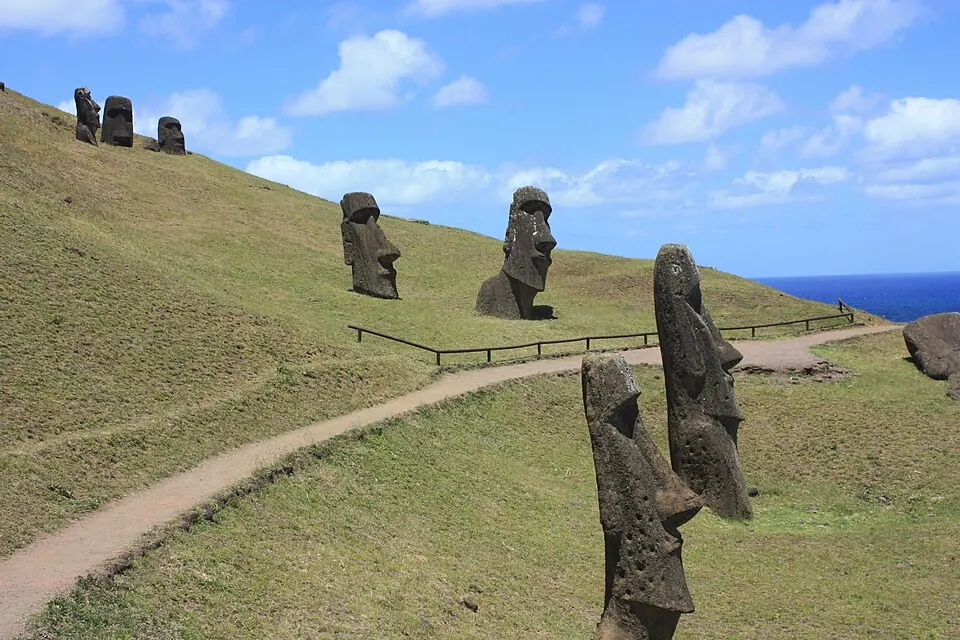
Rapa Nui, a South Pacific island among the most isolated inhabited places, whose national park has been inscribed as a World Heritage site since 1995, produced nearly a thousand monumental statues known as moai. It served as the reference for a narrative of ecological self-destruction, according to which deforestation caused the collapse of the society before any European contact. Genetic data do not confirm this. A severe demographic reduction leaves an identifiable signature: in a population reduced to a few hundred individuals, unions between relatives become unavoidable, and descendants inherit from both parents long identical segments deriving from a common ancestor, known as runs of homozygosity. The genomes of fifteen ancient individuals from the island carry none, which excludes a seventeenth-century collapse, and reconstructions based on radiocarbon describe a stable population. Those same genomes comprise about ten per cent Native American ancestry, acquired between 1250 and 1430.
Why it matters
The ecocide narrative served as an example in environmental literature, and its revision matters on two counts: for the present-day Rapanui population, whose ancestors it implicated, and for the assessment of collapse narratives founded on restricted documentation. The same genomes further establish contact between Polynesia and the Americas prior to any European navigation. The island's demographic catastrophe postdates European contact, and is linked to introduced disease and the slave raids of the nineteenth century.
Dating & uncertaintyDisputed
The date retained falls within the centuries of monument building. The contested point is the collapse: ancient genomes exclude a severe seventeenth-century bottleneck, radiocarbon-based models describe a resilient population, and deforestation, which is indeed attested, did not have the demographic consequences attributed to it.
Our species’ history as one day
23:57:082 min 52 s before midnight
if the 315,000 years of Homo sapiens were compressed into a single day