TECHNOLOGY
The Invention of the Transistor
1947 CE
History · Contemporary · Holocene · Meghalayan
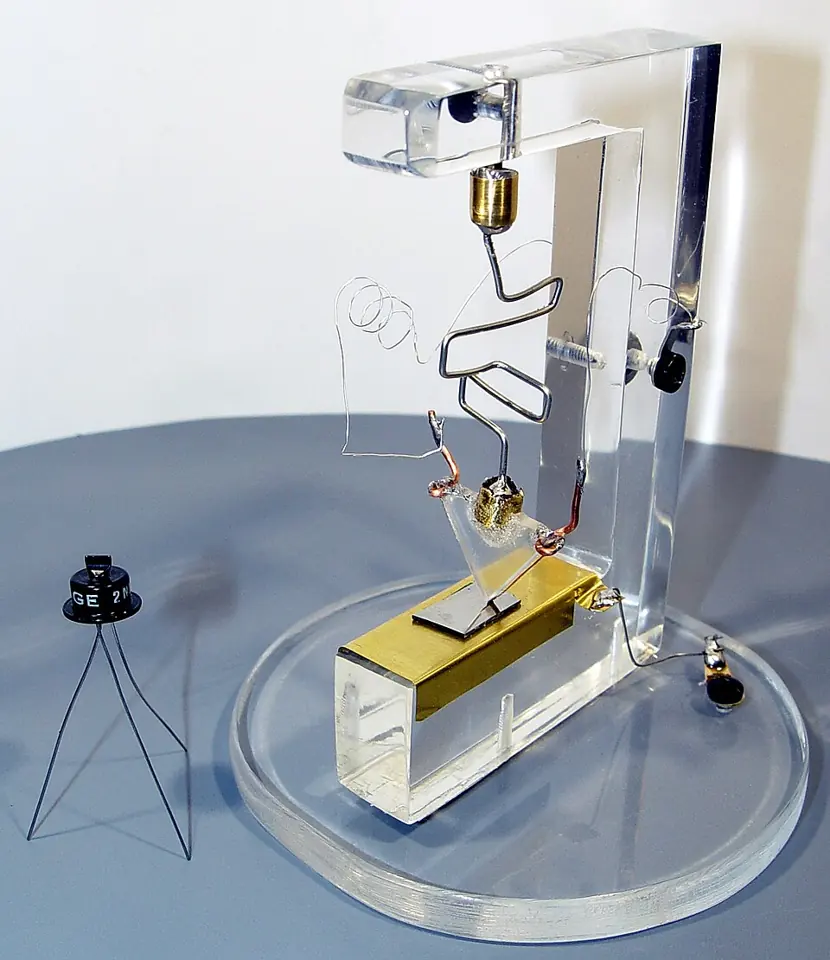
The transistor was demonstrated on 23 December 1947 at Bell Labs, a sliver of germanium under two gold contacts amplifying a signal without vacuum or heated filament.
The transistor is demonstrated on 23 December 1947 at the Bell Telephone Laboratories in Murray Hill, New Jersey, in the form of a point-contact device in which a sliver of germanium placed beneath two gold contacts amplifies an electrical signal, without vacuum or heated filament. Its operation rests on a property with two uses: a weak voltage applied to one terminal controls a markedly larger current between the other two. Metering that control produces amplification; saturating it in either direction establishes or interrupts the current, which constitutes a switch. The second use grounds the binary logic of computers. Dimensions have been reduced by a factor of the order of a million, and the field-effect variant known as the MOSFET, introduced in 1959, has been produced in more than a billion billion units.
Why it matters
The transistor constitutes the elementary component of all digital systems, Moore's law describing only the repeated reduction of its dimensions. Its history further documents a collective mode of invention: the device results from several decades of observations on the behaviour of semiconductor crystals and from partial realisations, which an industrial laboratory assembled and made reliable.
Dating & uncertainty
Bardeen and Brattain establish the transistor effect in December 1947; Shockley's junction transistor follows. All three receive the Nobel Prize in Physics in 1956. The dominant form, the MOSFET of 1959, is frequently described as the most produced manufactured object in history.
Our species’ history as one day
23:59:3821.7 s before midnight
if the 315,000 years of Homo sapiens were compressed into a single day