GENETICS
The DNA Double Helix
1953 CE
History · Contemporary · Holocene · Meghalayan
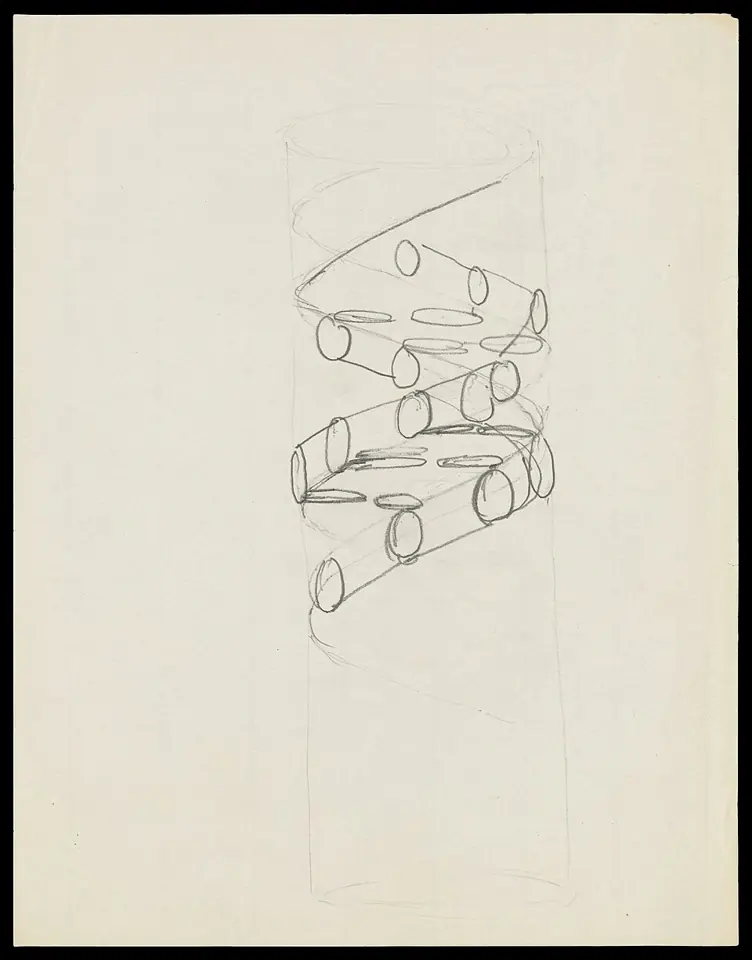
On 25 April 1953, James Watson and Francis Crick proposed the double helix of DNA, alongside the X-ray work of Rosalind Franklin and Maurice Wilkins at King's College London.
The double helix model of DNA is proposed by James Watson and Francis Crick in a paper published on 25 April 1953, issued jointly with the X-ray diffraction work conducted at King's College London by Rosalind Franklin and Maurice Wilkins. The diffraction image known as Photograph 51, obtained by Franklin, supplied the determining parameters of the model. The structure consists of two complementary strands: each base pairs with only one other, adenine with thymine and cytosine with guanine, so that each strand contains the information necessary to reconstitute the other. Separation of the two strands therefore allows each to serve as a template for the synthesis of its complement, and accounts for the replication of hereditary information.
Why it matters
The whole of molecular genetics, including the study of ancient DNA presented in this edition, proceeds from this structure and from the principle it establishes: heredity is information coded in sequence, capable of being read. The circumstances of the discovery, and in particular the communication of Franklin's data to Cambridge without her agreement, form part of the historical record.
Dating & uncertainty
The three papers appear jointly in Nature on 25 April 1953. Rosalind Franklin died in 1958, four years before the award of the Nobel Prize to Watson, Crick and Wilkins, a distinction not conferred posthumously.
Our species’ history as one day
23:59:3920.0 s before midnight
if the 315,000 years of Homo sapiens were compressed into a single day