TECHNOLOGY
Sputnik 1: the First Satellite
1957 CE
History · Contemporary · Holocene · Meghalayan
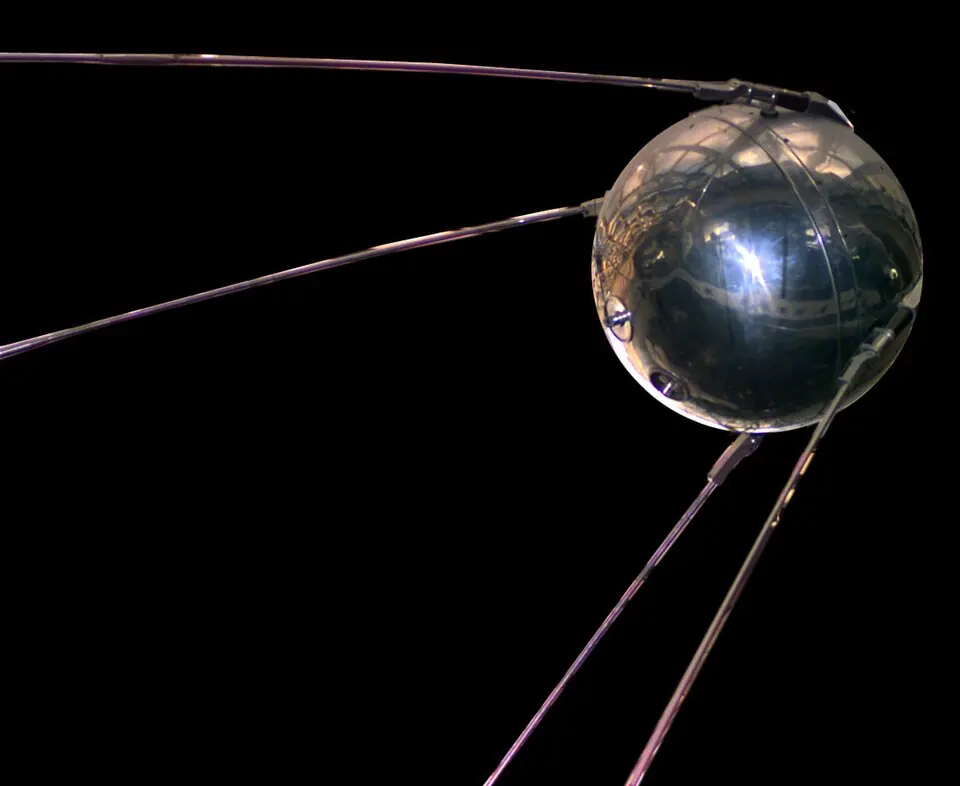
Sputnik 1, a polished aluminium sphere launched by the Soviet Union on 4 October 1957, was the first artificial object placed in orbit around the Earth.
Sputnik 1, a polished aluminium sphere 58 centimetres in diameter launched by the Soviet Union on 4 October 1957, is the first artificial object placed in Earth orbit; its radio signal, picked up by amateur operators worldwide, was transmitted for three weeks. An orbit is not an absence of gravity: the satellite falls continuously towards the Earth, like any object left to itself, but its horizontal speed is such that the surface of the globe curves away beneath it as fast as it descends. It therefore falls indefinitely without reaching the ground, which requires about eight kilometres per second. The launch opens the space age, its strategic consequences accelerating missile and lunar programmes.
Why it matters
Satellites have since constituted the infrastructure of communications, navigation, weather forecasting and Earth observation. Several of the measurements cited in this edition, on the ozone layer, ice extent or nocturnal lighting, proceed from orbital instruments. The launch further modified the scale on which the planet is represented, now observable in its entirety from outside.
Dating & uncertainty
Sputnik 1 is launched on 4 October 1957 and transmits from orbit for three weeks. Historians date the beginning of the space age from that autumn: the launch overturned the post-war strategic order and prompted the creation of large public research agencies.
Our species’ history as one day
23:59:4118.9 s before midnight
if the 315,000 years of Homo sapiens were compressed into a single day