SOCIETY × ENVIRONMENT
The Classic Maya Collapse
~850 CE
History · Middle Ages · Holocene · Meghalayan
Between about 750 and 950, the political institutions of the southern Maya lowlands came apart: dated monuments ceased, the great cities were abandoned and population fell.
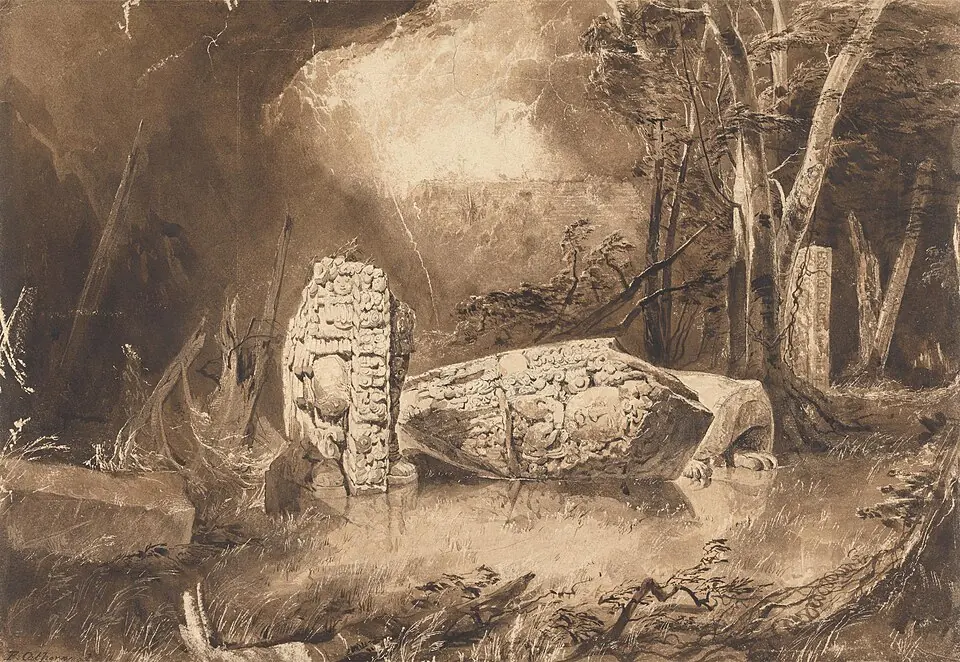
The Classic Maya collapse designates the disintegration, between about 750 and 950, of the political institutions of the Maya lowlands: the cessation of dated monument erection, the abandonment of the great southern cities and a substantial reduction in regional population. Climate archives supply the measure. Gypsum is deposited when a lake loses more by evaporation than it receives, and minute water inclusions remain trapped in its crystals, preserving the isotopic composition of the lake at the moment of formation; the gypsum of Lake Chichancanab, in Mexico, thus records annual precipitation reduced by nearly half. A precisely dated stalagmite from Belize further indicates that between 700 and 800 precipitation became not only deficient but irregular from year to year.
Why it matters
Maya civilisation did not disappear, Maya populations and languages being still present; what came apart was the political order. The case constitutes the principal reference for the study of climatic constraints exerted on a society. The most recent contribution concerns variability: an agriculture adapts more readily to durably reduced rainfall than to rainfall become unpredictable, which shifts the analysis from scarcity to uncertainty.
Dating & uncertainty
The disintegration of political institutions extends from about 750 to 950, the date retained falling midway. The droughts are quantified from lake gypsum and cave deposits: annual precipitation reduced by about 40 to 54 per cent, with maxima reaching 70 per cent, the Belize stalagmite further documenting the decline in interannual predictability.
Our species’ history as one day
23:54:375 min 23 s before midnight
if the 315,000 years of Homo sapiens were compressed into a single day