SUBSISTENCE
From Teosinte to Maize
~9,000 years ago
Neolithic · Neolithic · Holocene · Greenlandian
Maize derives from teosinte, a Mexican grass with short, hard ears, through a single domestication about 9,000 years ago.
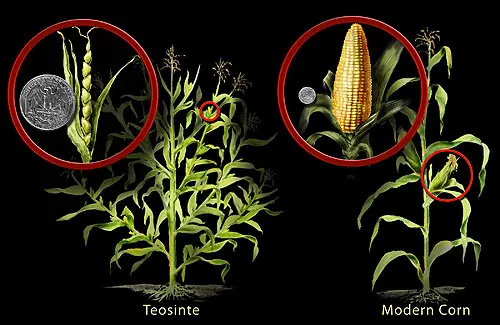
Maize, Zea mays, derives from teosinte, Zea mays subsp. parviglumis, a Mexican grass whose short, hard ears enclose a dozen grains within a silicified casing, a morphological difference so great that the descent was disputed for nearly a century. Genotyping of hundreds of plants established a single domestication, by a direct argument: all maize varieties draw on the same fraction of teosinte's genetic diversity, whereas independent domestications would have sampled distinct fractions. The origin lies in southern Mexico about 9,000 years ago, the oldest surviving varieties being those of the Mexican highlands, from which the plant spread through the Americas by two principal routes. Ancient cobs show a transformation still incomplete several millennia later.
Why it matters
Few cultivated plants have been carried so far from their ancestor by empirical selection alone, the silicified casing of teosinte having given way to a naked, hypertrophied ear incapable of autonomous dispersal. Maize constitutes the dietary base of Mesoamerican and Andean societies, and after 1492 of part of the Old World.
Dating & uncertainty
The date of 9,000 years is genetic in origin and rests on microsatellites, short DNA motifs repeated a variable number of times, whose high individual variability makes them an instrument for measuring kinship. Applied to landraces, they indicate a single domestication in southern Mexico. The oldest preserved cobs, at Guila Naquitz, are dated to about 6,200 years and already show no spontaneous disarticulation; those of Tehuacan, around 5,300 years, remain partially domesticated. The genetic estimate dates the beginning of the process and not its completion.
Our species’ history as one day
23:18:5141 min 9 s before midnight
if the 315,000 years of Homo sapiens were compressed into a single day