ENVIRONMENT
Tambora and the Year Without a Summer
1815 CE
History · Contemporary · Holocene · Meghalayan
The eruption of Tambora, in Indonesia, in April 1815, was the largest of historical times, and the next year Europe and North America had frosts in summer.
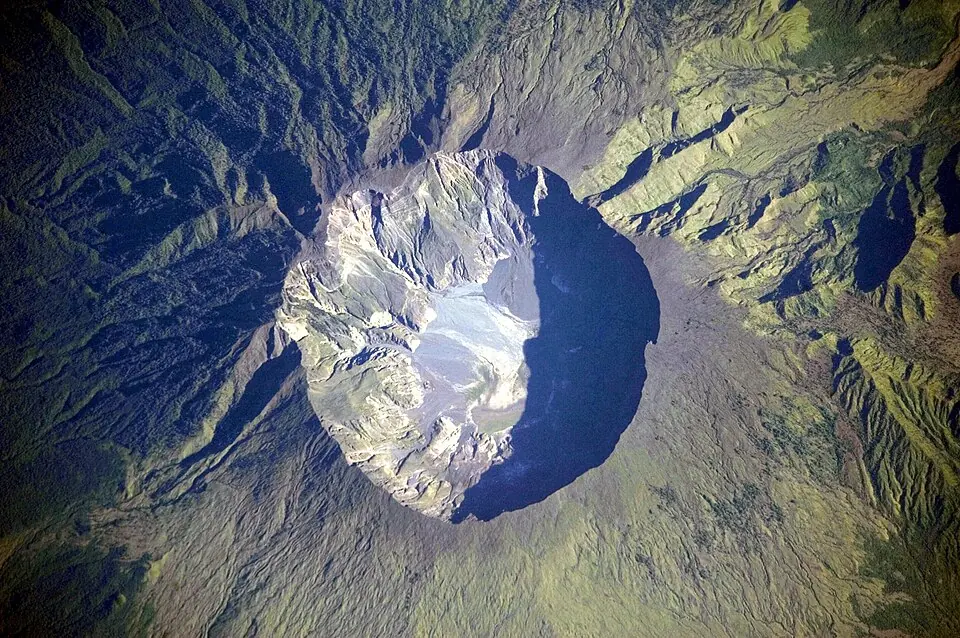
The eruption of Tambora, on the Indonesian island of Sumbawa, in April 1815, is the largest volcanic eruption of historical times, ranked 7 on the volcanic explosivity index. The following year, designated in the literature the year without a summer, Europe and North America experience summer frosts and deficient harvests, constituting the last major subsistence crisis of the Western world; snow and cold reach the rice-growing regions of southern China. The one-year lag is explained by aerosol dynamics: the veil of droplets injected over the tropics takes several months to distribute across both hemispheres, its effect peaking the following year. The monsoons also fail, through the same mechanism: a monsoon results from land warming faster than the ocean, and reduced insolation attenuates that contrast. According to a mathematical model of the climate run by Kandlbauer and colleagues, global cooling reaches about one degree in 1816.
Why it matters
The episode constitutes the modern reference for studying the effects of a major eruption on an interconnected economy, its consequences being measurable simultaneously in the price of grain in Europe and that of rice in China. It serves as a test case for climate models, bearing on the residence time of aerosols, the response of the monsoons and that of the carbon cycle.
Dating & uncertainty
The eruption occurs in April 1815, the cold year being 1816. Modelling gives global cooling close to one degree, a decrease in precipitation and a clear perturbation of the carbon cycle; Chinese archives document frost and snow as far as subtropical regions. The context was already cold, a solar minimum and an unidentified eruption in 1809 having preceded the event.
Our species’ history as one day
23:59:0257.9 s before midnight
if the 315,000 years of Homo sapiens were compressed into a single day