GENETICS × SOCIETY
Darwin: On the Origin of Species
1859 CE
History · Contemporary · Holocene · Meghalayan
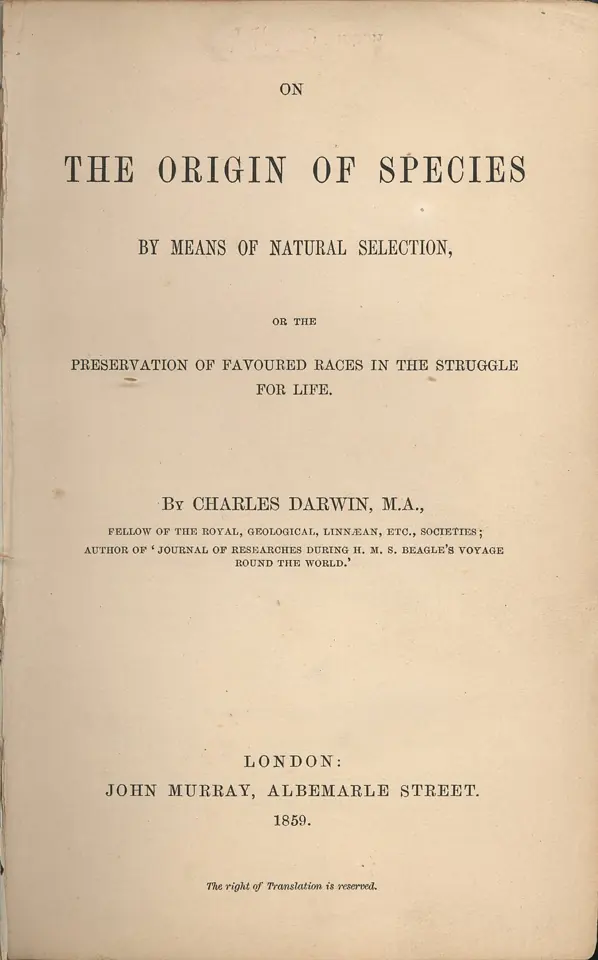
On 24 November 1859, Charles Darwin published On the Origin of Species, replacing a fixed world of species with a genealogy of the living shaped by natural selection.
On the Origin of Species by Means of Natural Selection, published by Charles Darwin on 24 November 1859, sets out a single argument substituting for the fixist world a genealogical organisation of the living: populations present variations, the bearers of certain variants leave unequal numbers of descendants, and the repetition of this process over sufficient time modifies species. The work rapidly secures adherence to the idea of descent with modification; the mechanism proposed, natural selection, takes longer to be accepted as a research instrument, and is in the interval the object of ideological uses.
Why it matters
The whole of the results presented in this edition, from fossil remains to ancient genomes, presupposes that the living world has a history and that this history can be reconstructed. The demonstration was established without knowledge of the mechanism of heredity, an absence that constituted a serious objection: if parental characters combined by blending, any new variant would be halved at each generation and would disappear before selection could amplify it. Heredity by discrete units, established at the same period by Mendel and left unread, answers it; the two bodies of work are brought together only in the twentieth century.
Dating & uncertainty
The work appears on 24 November 1859 and its print run sells out immediately. The share of historical necessity remains debated: the idea of evolution circulated before him and would probably have prevailed, whereas counterfactual analyses recognise for natural selection neither a direct precursor nor a full co-discoverer, which makes its appearance less predictable.
Our species’ history as one day
23:59:1445.8 s before midnight
if the 315,000 years of Homo sapiens were compressed into a single day