HEALTH
The First Surgical Anaesthesia
1846 CE
History · Contemporary · Holocene · Meghalayan
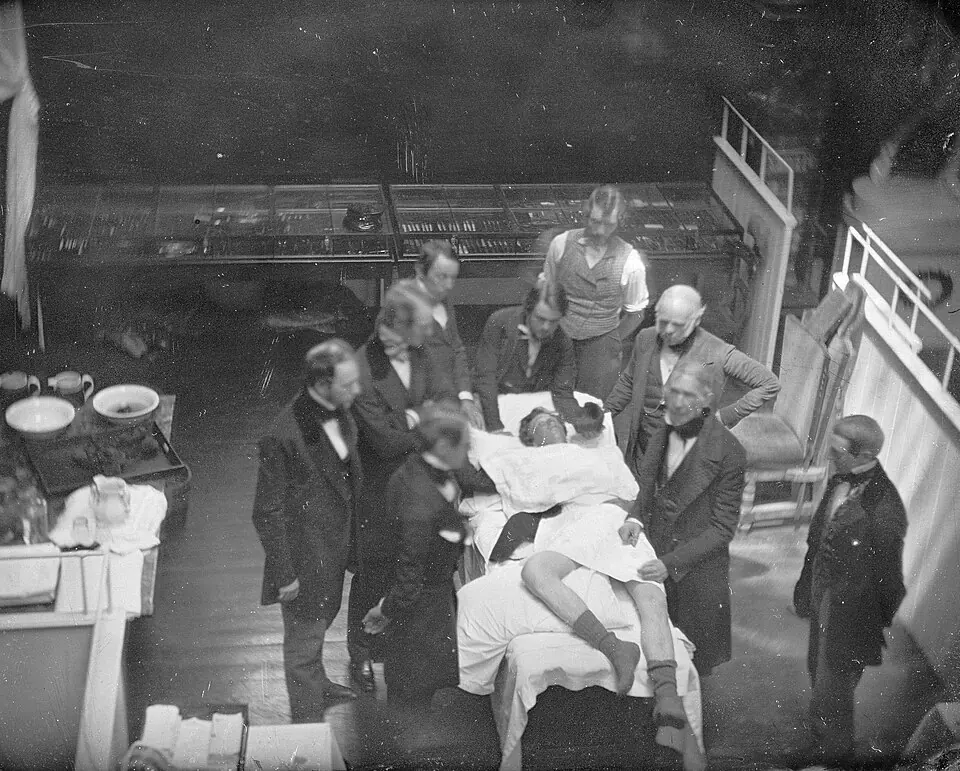
On 16 October 1846, in Boston, the dentist William Morton put a patient to sleep with ether while a surgeon operated: the first public demonstration of surgical anaesthesia.
The first public demonstration of surgical anaesthesia takes place on 16 October 1846 at the Massachusetts General Hospital in Boston, in an amphitheatre the event would cause to be named the Ether Dome: the dentist William Morton renders a patient unconscious with ether vapour, while the surgeon John Collins Warren performs the operation. The substance is not new, ether having been inhaled for decades recreationally; what is demonstrated is the possibility of dosage. Ether does not suppress pain but consciousness, by depressing the central nervous system until signals are no longer registered, and the therapeutic margin is narrow: an insufficient dose lets the patient wake, an excessive one interrupts respiration.
Why it matters
The suppression of surgical pain lifts the constraint of speed that limited surgery to brief and superficial interventions. Combined with the antisepsis deriving from germ theory, it makes practicable the opening of the thorax, abdomen and skull, and conditions the whole of modern surgery, including transplantation.
Dating & uncertainty
The demonstration of 16 October 1846 is reported in the medical press and taken up worldwide within months. Later refinements bear on the agents, chloroform and then intravenous products, on airway control by intubation, and on instrumental monitoring of vital functions.
Our species’ history as one day
23:59:1049.4 s before midnight
if the 315,000 years of Homo sapiens were compressed into a single day