HUMAN EVOLUTION × GENETICS
Sahelanthropus: the First Hominin
~7 million years ago
Phanerozoic · Cenozoic · Neogene · Miocene
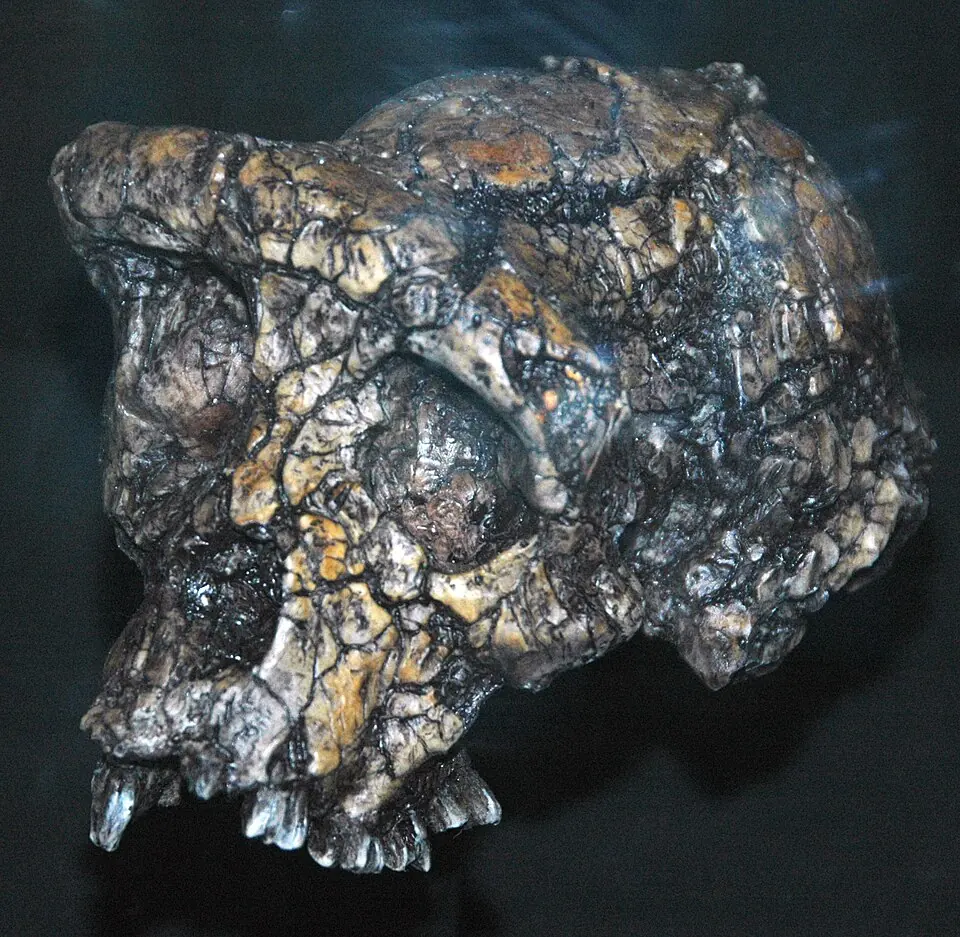
Sahelanthropus tchadensis was an ape that seems to have walked upright, known from a distorted skull and a few limb bones found in Chad and about 7 million years old.
Sahelanthropus tchadensis is a fossil ape from Chad that appears to have been bipedal, that is, to have walked on two legs. It is known from a distorted cranium, the skull without its lower jaw, and from a few limb bones. The foramen magnum, the opening through which the spinal cord enters the skull, is placed forward. That position is characteristic of a body carried vertically rather than of a quadruped. A femur, the thigh bone, recovered at the same site also indicates a body carried vertically. Two arm bones, described with the femur by Daver and colleagues (2022), indicate that the animal still climbed extensively. Sahelanthropus is about seven million years old, an age close to the genetic estimate of the date at which the human lineage separated from that of chimpanzees.
Why it matters
When the human lineage separated from that of chimpanzees, its members did not leave the trees. One animal both walked and climbed, and walking and climbing stayed combined in one animal for millions of years. Bipedalism was added to an arboreal life, a life spent in trees, and did not replace that life.
Dating & uncertaintyDisputed
Researchers place Sahelanthropus, about 7 million years old, and Orrorin, another fossil genus about 6 million years old, among the hominins, the members of the human lineage since its separation from that of chimpanzees. Both attributions rest on fragmentary remains and both are contested. Genetic estimates date that separation to between about 9 and 6 million years ago, depending on the generation time assumed, the average age of parents when their offspring are born.
Earth history as one day
23:57:462 min 13 s before midnight
if Earth’s 4.54 billion years were compressed into a single day