HUMAN EVOLUTION
The Oldest Homo Fossil
~2.8 million years ago
Phanerozoic · Cenozoic · Neogene · Pliocene
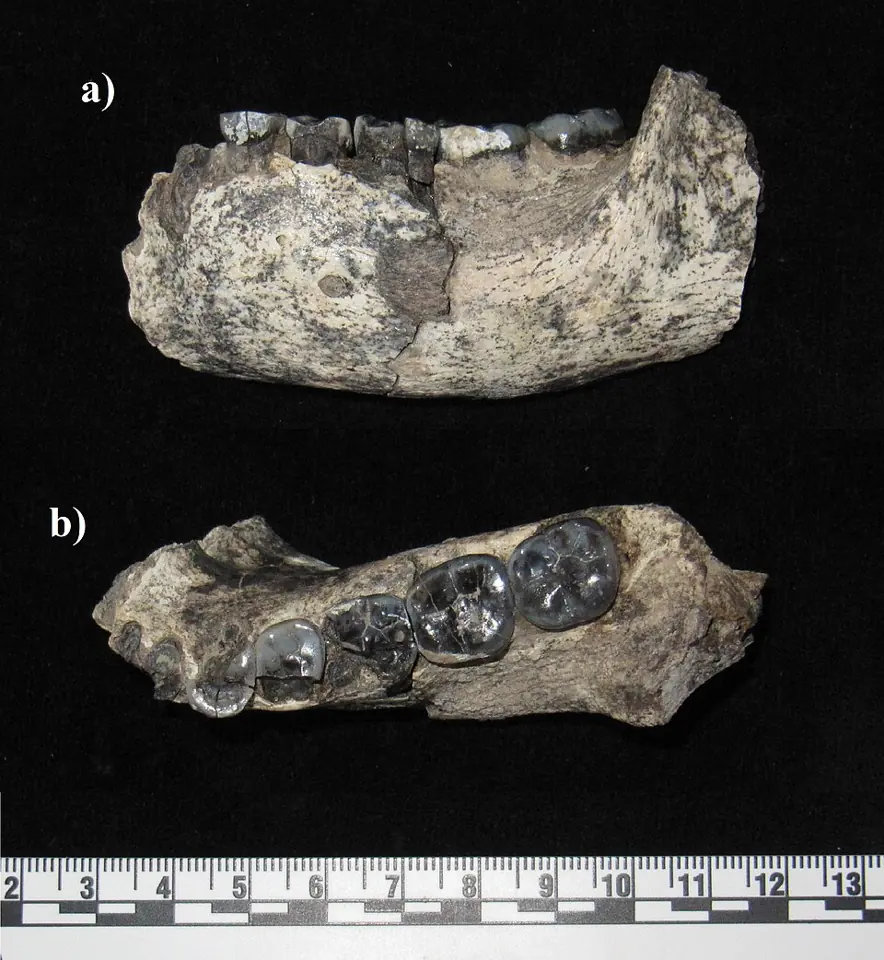
The oldest fossil attributed to the genus Homo is half a lower jaw found on a hillside in Ethiopia, 2.8 million years old, with teeth like those of later Homo and an older-looking front of the jaw.
The Ledi-Geraru jaw is the oldest fossil attributed to the genus Homo, the group of species that includes our own. It is half a lower jaw, recovered on a hillside in Ethiopia and dated to 2.8 million years ago. Its teeth have the features of later Homo. Its symphyseal region, the front of the jaw where the two halves meet, retains the morphology, that is the shape, of an australopith, a member of the group of human relatives that includes Australopithecus. The first tools of the Oldowan, an early tradition of stone tool making, appear about two hundred thousand years after the jaw. At Ledi-Geraru again, Villmoare and colleagues (2026) report an australopith at 2.63 million years ago that could not be assigned to any named species, and Homo again at 2.6 million years ago.
Why it matters
In the Afar, a region of Ethiopia, the genus Homo lived before 2.5 million years ago alongside another bipedal lineage, which did not lead to our own. The origin of Homo is therefore a branching within an assemblage of lineages living side by side, and not a succession from one form to the next. Most accounts of the origin of Homo omit that assemblage.
Dating & uncertaintyDisputed
Villmoare and colleagues published the jaw, catalogued LD 350-1, in 2015 in Science. Hawks and colleagues contested it in the same journal a few months later. According to Hawks and colleagues, once the comparative measurements are corrected, the specimen can no longer be attributed to Homo unambiguously. The debate has not been settled since. A single jaw is a narrow basis on which to date the origin of a genus.
Earth history as one day
23:59:0653.3 s before midnight
if Earth’s 4.54 billion years were compressed into a single day