HUMAN EVOLUTION
Laetoli and the Origin of Bipedalism
~3.7 to 3.2 million years ago
Phanerozoic · Cenozoic · Neogene · Pliocene
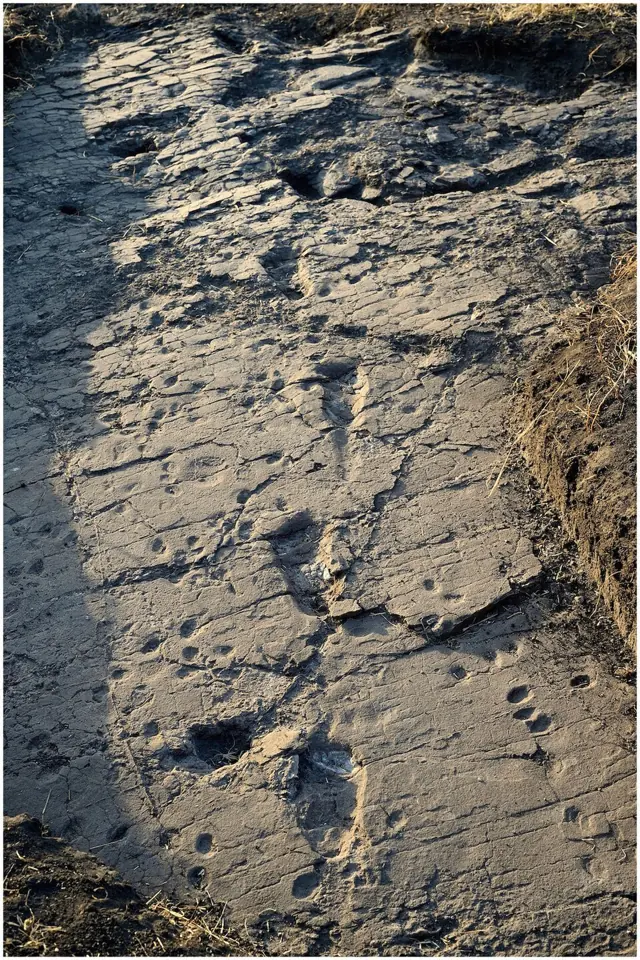
The footprints of Laetoli, left in volcanic ash 3.7 million years ago, record weight passing from heel to toe as in the modern human stride.
The Laetoli footprints are footprints preserved in volcanic ash, in which weight passed from heel to toe as it does in the modern human stride. Researchers long argued about the foot of Australopithecus afarensis, a fossil species of the human lineage, and the argument depended on a single bone. That bone is a complete fourth metatarsal, one of the long bones in the middle of the foot, described by Ward and colleagues (2011). Its head, the end towards the toe, is twisted against its base, as a transverse arch, across the width of the foot, requires. Both ends are angled, as a longitudinal arch, along the length of the foot, requires. The bone shows no trace of the flexible midfoot that an ape uses to grip. An arched foot transmits force and cannot grasp, which is the anatomical definition of a committed walker. The shoulders and arms of the same species were still built for climbing.
Why it matters
Bipedalism, walking on two legs, appears first in the human lineage: well before the increase in brain volume, and before stone tools and meat consumption. Bipedalism did not accompany a change of habitat, since the same animal continued to climb trees. The arch of the foot turns the foot into a rigid lever and cushions the shock of each step, which reduces the energy cost of prolonged walking. The lineage retained that prolonged walking.
Dating & uncertainty
The evidence for this bipedalism lies between two dated finds: the Laetoli footprints, 3.66 million years old, and the Lucy skeleton, a skeleton of Australopithecus afarensis 3.2 million years old. Researchers have debated since the 1980s what proportion of its time Australopithecus still spent in trees, and that proportion is not established.
Earth history as one day
23:58:501 min 10 s before midnight
if Earth’s 4.54 billion years were compressed into a single day