LIFE × EVOLUTION
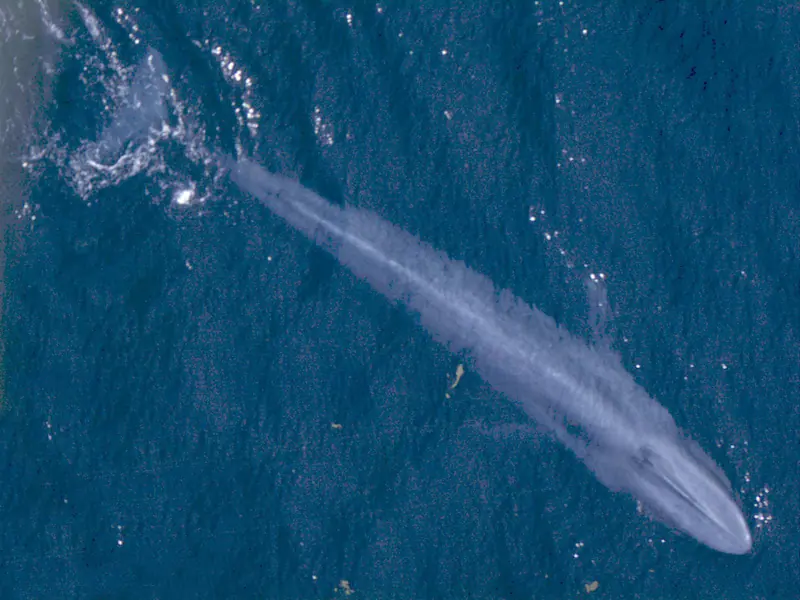
The Blue Whale: Largest Animal Ever
~4.5 million years ago
Phanerozoic · Cenozoic · Neogene · Pliocene
Baleen whales, which filter their food from seawater, were large but not gigantic for most of their history, and several lineages independently grew to the size of a blue whale only in the last few million years.
Whale gigantism is the growth of several lineages of baleen whales to the size of a blue whale. Baleen whales, or mysticetes, filter small prey from seawater through baleen, horny plates hanging from the upper jaw. Filter feeding is old, but gigantic size is recent. For most of their history the mysticetes were large but not gigantic, and over the last few million years several lineages increased in size independently. The total quantity of food in the ocean did not change, but its distribution did. Glacial cycles, the alternation of ice ages and warmer periods, concentrated the food into seasonal upwellings along the coasts, currents that bring nutrient-rich deep water to the surface. Concentrated food favours an animal able to travel far between patches of food and to take a great deal at each.
Why it matters
What matters to a filter feeder is the density of its prey, since the animal must swim through the prey, and not the total quantity of prey present in the sea. Dense, seasonal and predictable concentrations of prey favour an animal large enough to travel from one concentration to the next and to fast in between. The blue whale, the largest animal that has ever existed, is alive today, and its size appears to result from the ice ages.
Dating & uncertainty
Baleen whales reached their present size only in the last few million years. Slater, Goldbogen and Pyenson (2017) link that growth to ice-age upwelling on two grounds: chronological concordance, the two changes occurring in the same period, and body-size modelling. No direct measure of ancient food supply supports it. The threshold date, at which the increase in size begins, varies with the dataset.
Earth history as one day
23:58:341 min 26 s before midnight
if Earth’s 4.54 billion years were compressed into a single day