EARTH × EVOLUTION
The Isthmus of Panama Closes
~2.8 million years ago (contested)
Phanerozoic · Cenozoic · Neogene · Pliocene
The Isthmus of Panama, the strip of land joining North and South America, finished forming about 2.8 million years ago, a contested date, and animals crossed between the Americas in both directions after fifty million years of separation.
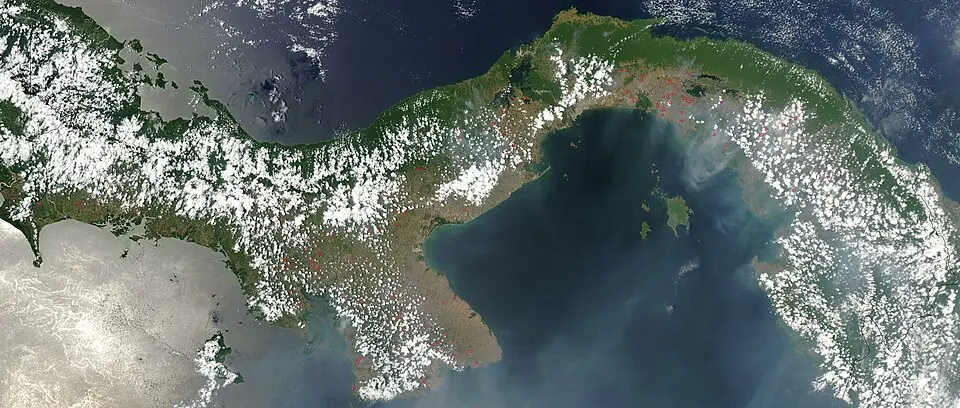
The Isthmus of Panama is the strip of land that joins North and South America. It formed as a chain of volcanic islands rose and the seaways between the islands, the arms of sea, narrowed. The last seaway closed about 2.8 million years ago. Animals then crossed in both directions after fifty million years of separation between the two continents, an event named the Great American Interchange. The exchange was asymmetrical: North American lineages were more successful in the south than South American lineages were in the north. The isthmus separated the Atlantic and the Pacific permanently, which reorganised ocean circulation.
Why it matters
Two continental faunas, the animals of North America and those of South America, met and mixed. The turnover that followed is the replacement of some species by others. It is one of the largest natural experiments available to invasion biology, the study of species that settle in a new region. The seaway closed gradually: the land emerged and the seaway narrowed over several million years, so that animals were crossing well before the isthmus was complete.
Dating & uncertaintyDisputed
O'Dea and colleagues (2016) combined geology, fossils and molecular data, drawn from DNA, and placed the final closure of the seaway 2.8 million years ago. Two published comments, one of them by Jaramillo and colleagues (2017), reject that date. Their authors argue, from the same categories of evidence, that land connections existed several million years earlier. The dating is unresolved.
Earth history as one day
23:59:0653.3 s before midnight
if Earth’s 4.54 billion years were compressed into a single day