SOCIETY × TECHNOLOGY
The Pyramids of Giza
~2560 BCE
History · Bronze Age · Holocene · Northgrippian
The three pyramids of Giza were built in some eighty years during the twenty-sixth century BCE, ten million tonnes of stone quarried and set in place.
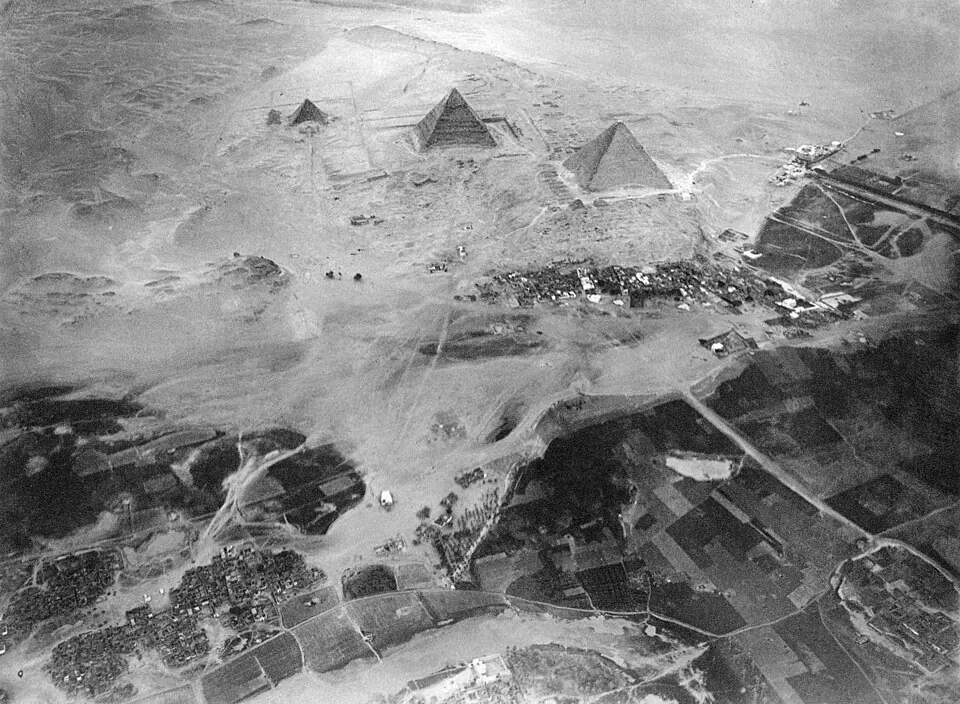
The Giza necropolis, in Egypt, comprises three pyramids, attributed to Khufu, Khafre and Menkaure, built in some eighty years during the twenty-sixth century BCE. The complex represents about ten million tonnes of stone quarried, transported and set in place, the pyramid of Khufu rising to 146 metres, a height that remained unequalled for nearly four millennia. Excavations conducted around the monuments have brought to light the corresponding infrastructure: workers' settlements, bakeries, ration lists and harbour installations receiving stone and timber conveyed over hundreds of kilometres.
Why it matters
The interest of the case bears less on geometry than on organisation: feeding, housing and directing tens of thousands of workers in rotation, over several decades, presupposes a constituted administration possessing writing, taxation and transport logistics. The pyramids thus document the capacities of an early state and the concentration of power over labour.
Dating & uncertainty
Egyptian historical chronology rests on the addition of reign lengths, whose reliability presupposes a complete and exactly transmitted king list, errors accumulating from century to century. Radiocarbon applied to short-lived plant material included in the masonry provides a foothold independent of that accounting. It places the accession of Djoser between 2691 and 2625 BCE, the Great Pyramid being conventionally placed around 2560. New high-precision measurements have settled the controversy between high and low chronologies of the Old Kingdom in favour of the former.
Our species’ history as one day
23:39:0320 min 56 s before midnight
if the 315,000 years of Homo sapiens were compressed into a single day