TECHNOLOGY × GENETICS
PCR: the Polymerase Chain Reaction
1985 CE
History · Contemporary · Holocene · Meghalayan
PCR, first applied by Kary Mullis in 1985, makes from a trace of DNA a very large number of copies of a chosen segment, by repeating a cycle of heating and cooling.
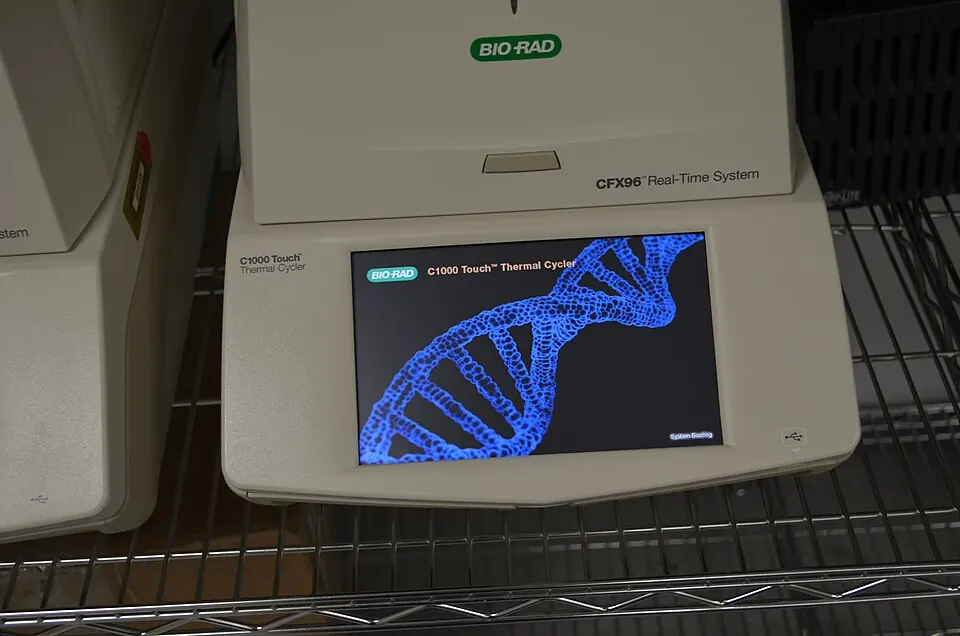
The polymerase chain reaction, or PCR, produces from a trace of DNA a very large number of copies of a chosen segment. The cycle comprises three steps: heating separates the two strands; cooling allows short primers to bind on either side of the target segment, thereby designating what is to be copied; moderate rewarming allows a polymerase to rebuild the complementary strand. At each round the quantity of target doubles, so that thirty cycles produce about a billion copies: the power of the method lies in this repeated doubling and not in the yield of the enzyme. Kary Mullis, who conceived the principle at Cetus, applied it experimentally in 1985 and received the Nobel Prize in Chemistry in 1993. The practical turning point comes in 1988 with a polymerase from Thermus aquaticus, a hot-spring bacterium, which survives the heating step: the machines, called thermal cyclers, can thereafter run cycles without intervention.
Why it matters
The scarcity of genetic material thereby ceases to be an obstacle. Biological diagnosis, forensic identification from a few cells, the reading of ancient DNA extracted from fossil bone and the tests employed in recent epidemics all rest on this amplification. The origin of the decisive enzyme, isolated from a bacterium of Yellowstone Park studied without foreseeable application, constitutes an argument frequently cited in favour of basic research.
Dating & uncertainty
The theoretical principle had been published in 1971 without practical consequence. Experimental application dates from 1985, the heat-resistant polymerase from 1988: amplification then exceeds a factor of ten million, and a single target present in a hundred thousand cells becomes detectable.
Our species’ history as one day
23:59:4811.2 s before midnight
if the 315,000 years of Homo sapiens were compressed into a single day