ENVIRONMENT
The Antarctic Ozone Hole
1985 CE
History · Contemporary · Holocene · Meghalayan
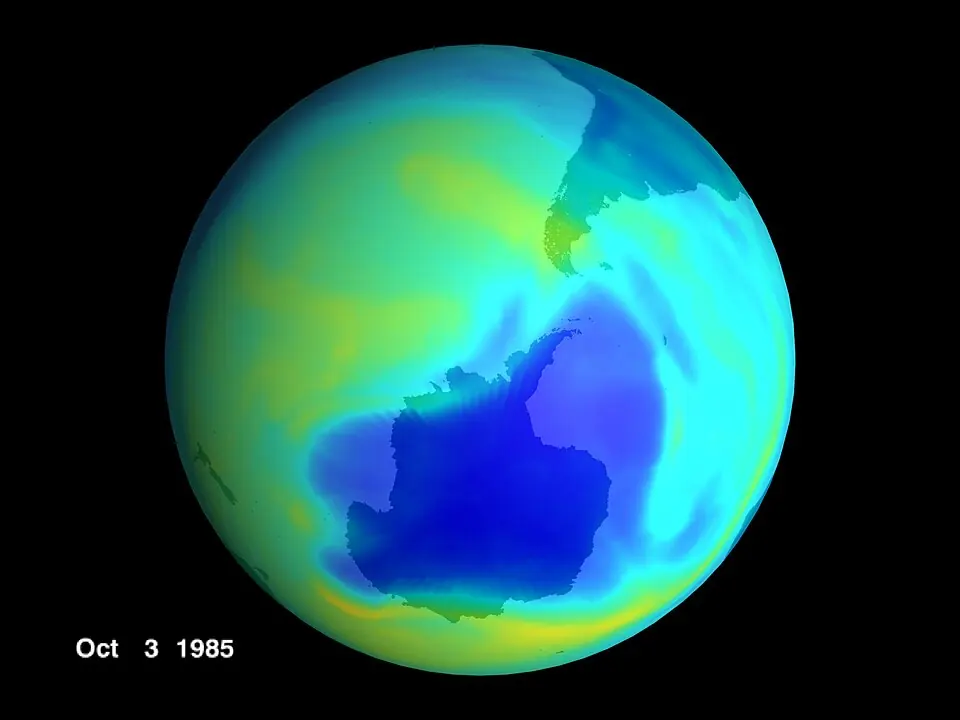
In 1985, the British Antarctic Survey reported a seasonal collapse of the ozone layer over Antarctica, caused by the chlorofluorocarbons used in aerosols and refrigeration.
The Antarctic ozone hole is the seasonal decline in stratospheric ozone concentration over Antarctica, reported in 1985 by the British Antarctic Survey from ground measurements begun several decades earlier. Its cause is the emission of chlorofluorocarbons used in aerosols and refrigeration. The mechanism is catalytic: these compounds are stable enough to reach the stratosphere intact, where ultraviolet radiation breaks them down and releases chlorine; an atom of chlorine then destroys a molecule of ozone and emerges unchanged from the reaction, able to begin again thousands of times. A small quantity therefore suffices to produce considerable effects. The Montreal Protocol, adopted in 1987, organises the elimination of these compounds; it is to this day the only United Nations treaty ratified by every member state.
Why it matters
In 2016, September measurements and models agreed on the beginning of a recovery of the layer, legible in the ozone column, its vertical profile and the area of the hole, volcanic eruptions having intermittently disturbed the trend. The case is cited in climate negotiations as a precedent of effective international action: detection by long-term instrumental monitoring, attribution by chemistry, a treaty two years after publication. The initial industrial choice moreover weighed, bromine being in this role an even more efficient catalyst than chlorine.
Dating & uncertainty
Publication dates from 1985, the protocol from 1987, the finding of recovery from 2016. Full recovery is expected in the second half of the twenty-first century.
Our species’ history as one day
23:59:4811.2 s before midnight
if the 315,000 years of Homo sapiens were compressed into a single day